Thursday, April 10, 2014

First blog from teachers

Well, Meru has changed our lives…as dramatic as that sounds, its true. We came here as four students, somewhat naïve in what we were about to experience. We knew that our paradigms would shift, how much of a shift was nothing short of outstanding. I apologize for the delay in this post, as we are fortunately without internet access at our apartment.

            Upon arrival, the sweet smells of Nairobi entered our lungs as we inhaled our first breath of air. Perhaps it was flowers, perhaps it was the fact that we had been relaying from airport terminals for the past 20 hours. Regardless, to have our feet on solid, Kenyan ground, felt comforting. Henry was there to greet us, along with Simon and Susan, all equally making us feel at home instantaneously. In our exhausted excitement we commented in awe at the Acacia trees, donkeys on the highways and cows crossing the road. Kat experienced an awful journey, suffering from an equal concoction of those damned malaria pills and a potential flu bug…not to mention flight anxiety. However, with the help of the angels at the Anglican Guesthouse, she was comforted by new friends, and comically Fanta with salt. The next day we met with Mamma Jen for the first time (truly deserving of that name). She got us amped and ready for the 4 hour drive to Meru.
            It seems like months ago that we had that first journey to our new town. I remember analyzing and observing the people as we drove, my mindset completely different than what it is now. I remember almost pitying them, for their lack of technology, electricity, and proper housing. I remember feeling bad for them, for wishing for some common solution to help them all. I remember being scared to eat their food, to drink their tea, to live their lives. I never thought of myself above them, but I did think my way of life was easier. I now understand, that our Westernized way of life is not easier at all.
            We are consumed my technology, not only ruining our environment, promoting child workers, and racking our bank accounts, but also driving us away from each other. We have phones that communicate instead of our mouths, ipods that allow us to segregate ourselves from the rest of our peers, and big houses that ask us to be alone, locked behind the doors of our own bedrooms. We eat food from around the world and have mega superstores, but what we eat is pumped with hormones and filled with toxins making us sick. We may have vehicles, but our lack of exercise has made our country obese and fragile. We have so much, yet hardly share our wealth, in fact, I’ll go as far as to say forgotten how to give.
            Maybe the Kenyans don’t have our prestigious lifestyle, with our cars and our clean houses and our flashy material goods. But what they have is better, they have a sense of community. They are healthy, strong-bodied individuals, who have people that care for them and family that love them. They have nothing and give everything. They are unaffected by this demanding sense of time management we have in Canada. They walk and talk, about the big things, and the little things. They eat local food, unaltered by toxicity and import, minimizing their carbon footprints. They don’t use their lights in the day, because sunlight is more than enough. They do not waste, they do not care for vanity, and strive for comfort rather than attaining uncomfortable stilettos. The children are independent, grateful, eager to learn, undistracted by technology…not to mention killer fast runners. So yea, I have an Ipad, but what I don’t have is strength and acceptance from community.

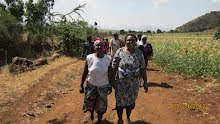
Photo sent to FHF by Mwenda which he entitled as Carolyn Francis introduced her teachers to Ruuju students

Monday, February 17, 2014

Breast examination


One of our volunteers in Kenya, Janet Dykerman,  is a mammogram technologist on Prince Edward Island.
Since breast cancer is all too common in Kenya, we asked her to explain to women how to check their breasts for lumps or changes in their breasts.
When we held focus groups or had other meetings, Janet met with small groups of 10 people or less for a half-hour and explained why and how they should check their breasts regularly for any changes.  She gave them a fact sheet she had compiled and she had a synthetic breast they could examine for lumps.
She told them she was not a medical doctor and that if they found changes in their breasts they should consult a medical doctor. 
All women were very appreciative and told us they had not been told this previously.   

Saturday, February 15, 2014

Gathering information


By Teresa Mellish
On this visit to Kenya we  gathered  information for the final report on the Food Security project.

One way of doing this was to interview women on their shambas (farms). It’s a wonderful opportunity to see their screenhouses and greenhouses.
We randomly select the women and then travel to their farms.
They are always cooperative and willing to answer our questions. They always offer us tea and frequently give us a few eggs, some mangoes, passion fruit, a few pieces of sugar cane or some delicious plums.   All we have to give them is a 2014 calendar.   
Here are two pictures- one of Ilse interviewing a woman on her shamba (with Salome translating)  and the other of fruit we were given over a couple of days.

Training on financial record keeping


Ron Herbert, a retired accountant and a volunteer with Farmers Helping Farmers,  taught two classes of basic financial record keeping to the Directors of five dairies we work with in Kenya.

The approach he took was to show the farmers how they could keep financial records on their own shambas.    He developed the curriculum for 4 sessions for each dairy and a Kenyan will teach the other two sessions. 
We have tried to have Kenyan accountants teach accounting and they try to make accountants out of our partners by making it too complicated.
 Even though most farmers don’t like bookkeeping, it’s a necessary part of any business, including farming.   The Kenya dairy farmers were appreciative of the training- they even did their homework between the two sessions!!
One of the attached pictures shows a few farmers discussing the training. They are seated under a large avocado tree near Karatina which provides shade- it is the most pleasant classroom in the world. The other one shows Ken Mellish presenting a laptop computer to the Dairy Chairman so they can start computerizing their milk records.  This laptop was donated to us.


Thursday, February 13, 2014

Imagine the excitement of unveiling three Village Feast cookhouses


Village Feast members, Jolyne Sharkey and Ilse Peters-Ching were excited to open three cookhouses at three schools during the past couple of weeks.
The construction of the  cookhouses and the energy efficient cookers were paid for by the Village Feast over the past few years.
The cookhouse is a kitchen where the morning porridge and the lunch stew are prepared and served to the school children.   The children’s parents provide the maize and beans for the stew and Farmers Helping Farmers with their partner DFATD support  a school garden to produce vegetables for the stew with funds from the Village Feast for the school gardeners wages.
The three schools are all primary schools with over 200 children at each school  from nursery to standard 8.
The schools are all twinned with Island schools as follows:
Mitoone Primary School  is twinned with West Kent Consolidated School
King’O Primary School is twinned with Gulf Shore Consolidated School
Marinya-a-Ruibi Primary School is twinned with Margate  Pastoral Charge 
During their time in Kenya Ilse and Jolyne also visited four other cookhouses sponsored by the Village Feast.
Thank you Village Feast! You are making a huge difference in the lives of the school children at these schools.


We visited Shaad Olingo's farm


By Teresa Mellish

Last weekend, Ken, John, Eddy and I visited Shaad Olingo’s farm in Muhoroni.  I know that all of the people who have volunteered in Kenya over the past 30 years  with Farmers Helping Farmers know Shaad and will recall his wonderful hospitality.  We tell all of our volunteers to feel free to ask Shaad anything- because there is nothing he has not been  asked before by Canadians!


Anyway back to the farm, Shaad’s farm, called GAD-Hortec (named after his three sons) is a two hour drive from Nakuru on the highway to Kisumu.  It has black soil and most important, it has lots of water!!!
He is presently growing bananas, mangoes and papaya.  He has also grown tomatoes, onions, kale and potatoes.
He wants to dig a pond to store the water and then irrigate his crops with the stored water.  
The area where his farm is located  in Nyanza county – we saw fields of sugar cane and we learned that the county is food deficient so he should have no trouble selling the food he produces.
It was a wonderful farm which Shaad was delighted to show us.


Eddy Dykerman discusses vegetable production with Gikundi


Brookfield Gardens Eddy Dykerman shared his vast experience in vegetable production with Gikundi M'Muguna , the horticulturist with the Muchui Womens Group in Kiirua  this week.  Gikundi visited Brookfield Gardens for a week in the summer of 2013 when he visited PEI.
The project funded by DFATD and the Andreas Baur Foundation aims to improve food security and  includes the production of vegetables in screenhouses and greenhouses.  
Eddy was with a team of 11 volunteers with Farmers Helping Farmers who are working in Kenya for three weeks.

Friday, February 7, 2014


Cattle and Chaos Collide –A Veterinary Students Experience in Kenya

On one of our favourite days in Kenya so far, we had a walk-in clinic organized by the Muchui Women’s Group in conjunction with Dr. John van Leeuwen and his veterinary students, with the help of StephenChandi and LeahKarioki, FHF’s in-country staff.Locals brought their cattle to be dewormed or treated for suspected illness. In this area of Kenya,cattle are grazed in a pastoral style system.

The day wasorganized chaos- people yelling, cattle running around on the loose, bulls fighting in the holding pen, cows jumping over and breaking through gates. It was awesome! We saw over 400 animals and it was very rewarding and felt as though we were making a very big impact. We divided into two groups, one group deworming and the other examining and treating sick cattle. Both spots were very enjoyable. It was interesting to see the variety of cattle breeds: Brahman, Zebu, Holstein, Jersey, Guernsey and every combination.We sawmany diseases that we don’t encounter back in Canada, mostly tick-borne diseases such as East Coast Fever (Theileriosis) and Anaplasmosis, along with conditions caused by overexposure to sun, such as cataracts.

Over the course of our three weeks in Kenya, we are educating farmers on nutrition, milk quality and animal care.At the walk-in clinic, we gained a greater appreciation of the problems faced by smallholder cattle farmers in Kenya and are looking forward to making the most of our remaining two weeks in the country.


Michael, Alexander and Marianne – Senior Veterinary Students from the Atlantic Veterinary College.

Wednesday, November 6, 2013

NF2 50/50 Benefit Dinner

After arriving home from Kenya in February 2013 I have been considering ways that I can continue to support the work of the womans groups from my home farm and community in Nova Scotia.  My hope is that here in Nova Scotia we can create a strategy to have a long term continuous stream of funds to carry out the work of FHF. I am really excited annouce that NF2 (No Farms No Food) has choosen Farmers Helping Farmers for their 50/50 benefit fundraising event. 

The event raises funds in support of sustainable agriculture and land preservation locally and afar.
 
It is the 3rd Annual "You Don't Know What You've Got 'Til It's Gone" benefit dinner at the Old Orchard Inn

Thursday, December 5th at 6 p.m. 

It's going to be a wonderful evening to kick-off the Holiday Season in a fun & meaningful way. We’ll once again be able to enjoy a bounty of local foods including a whole spit-roasted pig from Meadowbrook Farms. And we look forward to tasting a typical vegetarian Kenyan dish, too. Musical performances will keep us entertained and we can finish, or perhaps begin, our Christmas shopping before or during dinner with the always-diverse silent and live auctions. 

The evening's proceeds will be split 50/50 between the Annapolis Valley Farmland Trust and Farmers Helping Farmers (to help with the final year of their three-year horticulture project working with women’s groups in the Kenyan communities of Marega and Kiirua). 

Tickets are now available.  Please share with your Nova Scotia Friends, or come join us from PEI.  For more information visit the facebook page: https://www.facebook.com/pages/NF2-No-Farms-No-Food/137602539594998?ref=hl OR you can email me: Patricia@taprootfarms.ca


Monday, October 21, 2013

Studies Abroad

Studies abroad

Mary MacKay
The UPEI team of Vanessa Dennis, third from left, Alicia MacDonald, Sydney Abells, Jennifer Whittaker, Megan Ellis and Danielle Perry spend 90 days each in rural Kenya participating in health and agricultural projects to increase food security and health of Kenyan women and children.

UPEI nursing, biology and Atlantic Veterinary College students reflect on their 90-day internships in Kenya

This was the second study time round in Kenya for Dr. Shauna Richards, who was involved in ongoing projects that are a partnership between Farmers Helping Farmers (FHF) and the Atlantic Veterinary College (AVC) in Charlottetown.
This time her research focused on whether improving the nutritional content of cow feed and fodder is a cost effective way to boost milk production.
“All of the projects have the goal of improving dairy farming but the fourth year rotation is about practising clinical medicine, so treating sick animals and dealing with certain types of diseases that we wouldn’t see, normally. But this project was specifically focused on improving milk production through nutritional sources,” says Richards, who is now a grad student, studying for her masters of science.
“It’s not just trying to improve one thing, it’s trying to improve a whole system of milk production, which affects more than just one farmer. It also affects the local economy there to have a better milk producing system.”
FHF has for many years worked closely with Wakalima Dairy Group, which started off as a co-operative of small individual farmers  who would pool their milk daily to sell to a processing plant.

“They got bigger and bigger as time went on with help from Farmers Helping Farmers and now they are an actual business because they just got too big to be a co-operative anymore. There are over 6,000 farmers selling their milk every day and they have two bulk tanks like they would have here for cooling milk. . . and they are starting to build a processing plant so they can process and sell their own milk,” says Richards, who was worked in Kenya with two veterinary students from Vets Without Borders.
Most farmers have one cow but not more than five so that alone was a different experience for this Canadian veterinarian.
“I really like working on the scale of smaller farmers because you get to work with them on a more individual basis and they work with their cow on a more individual basis too. It’s their livelihood and it’s a really important part of their farm,” says Richards.
Most cows are fed locally grown forages and a small amount of grain.
The research focused on whether higher feeding of grain will improve milk production to a point where the monetary return outweighs the added expense.
“We wanted to see if purchasing these (locally produced) feeds was economical for these farmers. . . . We wanted to make sure that they’re going to be able to make money with the additional milk that their cow is going to produce when they buy these feeds,” Richards says.
“They all know that feeding more feed is going to help their cow but they’re quite concerned economically because buying that bag of feed means money from somewhere else. . . .”
This year’s study involved feeding measured amounts of the locally grown forages and purchased feeds to the cows and keeping track of the milk being produced.
While the actual statistical verdict is still out because the full examination of the data will not be complete until early in 2014, there was a pilot study done last year by a graduate student from the University of Nairobi, which is also a partner on the project.
“And based on (that) pilot project we’re optimistic that it’s going to be beneficial,” Richards says.
“It was really great to be out in the field and working with farmers, and especially because we got to go back over and over to these farms again to see them. So it was nice because we got to build an actual relationship with them, it wasn’t just a one-time visit.”
The opportunity to travel and to do research was a dual draw for UPEI biology students Alicia MacDonald and Jennifer Whittaker, who were in Kiirua for 90 days conducting research that focuses on factors that contribute to respiratory problems in women and children.
“I think my favourite part was being integrated right into the community,” says MacDonald, who spent much of her time with a test group of 45 women assessing the value of more efficient cook stoves in reducing the exposure to wood smoke.
“I don’t have the results yet because (the data is) getting analyzed now but we’re thinking from the comments that the women made and from the testing that the chimneys are having an effect: that their cough is significantly less, that their eyes weren’t bothering them, because women are typically in a cookhouse between three and six hours every day. . . . They cough a lot and it’s a major cause for COPD (chronic obstructive pulmonary disease),” MacDonald says.
This final round of data will be compared to a study that was conducted two years ago just after the installation of the energy-efficient stove and chimney systems, which were donated by FHF.
“They are very happy with the stoves. We never heard a complaint from any of the 45 women,” she adds.
While MacDonald was focused primarily on indoor Studies
... Cont. from C1
air quality, Whittaker directed her attention to the great outdoors for a baseline study to determine the level of air pollutants, such as the exposure of road dust on children walking to and from school.
“My (research) is on outdoor air quality,” she says.
“Basically there are a lot of dirt roads in the area where we were so my supervisor was thinking that was probably a high source of pollutants, especially for the women and children there because they’re constantly walking back and forth, they spend most of their time outside and there’s a lot of open air fires. So I was setting up the baseline data for the amount of pollutants that were in the air to see if it’s worth studying to see if there is a significant impact on their health.”
Whittaker placed a series of eight air samplers along the road to calculate the total particles in the air to compare with research that has been done in other areas and World Health Organization guidelines.
She also made note of the amount of pedestrian and vehicle traffic at certain times of day.
Her work will provide the baseline data from which future UPEI biology students can make comparisons.
Both UPEI students adapted quickly to their unfamiliar surroundings and made do surprisingly well without their usual easy access to the lab, the Internet and uninterrupted electricity.
“We learned very quickly to always have our laptops charged because at least if we lost electricity we could use them for a little while,” Whittaker laughs.
“The hardest hit was not being able to just be able to search for (information) when I wanted it. If I thought of a question usually you just go to your phone or your computer and just Google it right away. And so I had to write things down so I’d remember to look things up when I had the Internet or stay up till the middle of the night when the Internet was working a little bit better.”
Fourth-year UPEI nursing students Danielle Perry and Vanessa Dennis explored avenues of a whole new working world during their internship working at a small rural hospital in Kiirua.
The UPEI students’ focus was on sharing best practices in the areas of immunization, maternal child health and more.
“The health care is very different from here. They don’t have as many resources as we do, (but) a lot of the doctors are really smart and very creative. Here we would have everything, so if we wanted to put a catheter in we would have a catheter, if we needed drains, we would put drains in,” Perry says.
“But there, sometimes they had to use catheters for drains (for example). They were just really innovative. So if they had one piece of equipment they could use it for five different things where we would have the specific tools for each.”
The mental comparisons didn’t stop there for Perry, who did a rotation in Charlottetown in maternity and surgery before she headed to Kenya where she did a month of each there.
“It was just hard to see that some people couldn’t afford to get the surgeries because almost everything is out-of-pocket there. Because you have public insurance and private insurance and not a lot of people can afford the private, so most people had to pay out-of-pocket for their surgeries and they couldn’t afford it,” she adds.
“Room-wise there’d be six or seven people to a room, whereas here people complain if there are two people in a room. . . .”
Working alongside the Kenyan medical personnel was an amazingly unique experience for both.
“I got to scrub for a lot of surgeries, which I wouldn’t have got the chance to do here,” Perry says.
“Even when you’re a registered nurse (here) you’re allowed to scrub in and pass utensils but you’re not allowed to assist in the surgery, whereas in Kenya I was passing tools, I was using retractors, I was assisting in the actual surgery. I even got to make a few little cuts, which I would never get to do here.”
Perry and Dennis did presentations to hospital staff about Canadian standards of practice in the areas of post-surgical care, for example, and procedures like transurethral resection of the prostate, which is being implemented in Kenya in the coming year.
“We did some education sessions (at a local clinic where they also worked) and through working with them the whole summer we got to find out what their core beliefs were,” Dennis says.
“So then we found out how they believe that they shouldn’t breast feed a child while they have mastitis, but we’ve been taught through best practices ways that you should for multiple reasons. So we taught them that they should do this and made a point to connect with as many people related to that enforcement that we could (to share that information).”
This on-the-job training venture was like nothing Dennis could have ever expected.
“I learned so much. The thing that I really enjoyed was getting to do procedures and skills and different things there that we would never have the opportunity to do here as student nurses,” she says.
“I got to conduct births, help women deliver their babies, whereas here that’s not something the nurses do unless they absolutely have to. It’s something for the OBGYN or the doctor. But there the nurses do that. The nurses have a broader scope of practise and I was able (with training and guidance) to be included in a part of that."

Wednesday, September 11, 2013

Making movies and cuddling babies


Megan and Sydney here- the nutrition interns from UPEI.  We have recently returned from Kenya, and wanted to bring you up to date on some of the work we did in July and August (now that it is easier to upload blogs and pictures!).

Over the summer, we worked on three projects: 1) the assessment of food security and diet among women in the Muchui and Ruuju women’s self help-groups 2) using a ‘train the trainer’ model with women ‘champs’ to teach women and men in the broader community about nutrition and healthy family meals and 3) the development of an infant feeding resource to improve the nutritional quality of infant foods and to extend the period of exclusive breastfeeding. This blog is about the final one-where we developed a video which can be used by the local St. Theresa’s hospital to educate women from the community.  It is our first ever experience as directors and videographers!

 Before we developed a video, we had to decide what information was needed, and what approach to take. That took a fair bit of interviewing and research. Our professor Jennifer (Prof Jen) provided us with information and concerns identified from previous nutrition interns [Amy, Harrison (2011); Kaylynne and Christina (2010)]; we also had the guidelines for infant feeding from the World Health Organization which would form the basis for our recommendations. 

Our first step was to meet with women in their homes and in the hospitals to get an understanding of what their infant feeding practices were. We also met with healthcare professionals such as dietitians, HIV advisors and nurses to get an idea of what the teachings around infant feeding were. Most of the women understood that breastfeeding was good for their baby but were unsure of how long to breastfeed for; many women breastfed for only one month before giving their baby solid foods.
We spoke with one of the new mothers (she had a healthy baby boy on July 10th) who had not yet received any nutrition education from Caroline the dietitian (who was hired in 2012 after one of the UPEI nutrition students (Harrison) recommended they do so!). We were concerned about some of this mother's responses. She would be returning to work in three months and would no longer be able to breastfeed her child. She thought that because she was going back to work, there was no other alternative but to resort to a formula made with cow’s milk, bananas and Irish potatoes for her child.  She also told us that her mother said that the baby needed to be fed water immediately as well, or it would become dehydrated.  After interviewing the women and Caroline, we were reassured that one reason behind women weaning their infant too soon, or introducing less nutritious foods was a lack of knowledge and that our video could, in fact, help. We also believe that hiring a Dietitian was one of the best choices that St Theresa's Hospital could have made! Caroline is working with all the new mothers and educating them on the importance of exclusive breastfeeding, and complementary feeding once the child becomes six months old.  Our video can be one tool that she can use to help women from the surrounding community who come to the hospital.

 The information that we got from talking to the women and healthcare professionals helped us to decide what we needed  to include in the video. We developed an outline for the video and had it reviewed by Prof Jen.  After an introduction, we would cover benefits of breast feeding exclusively for 6 months, concerns and myths about breast feeding and infant feeding, and the how/when/what of introducing solid or complementary foods. We wanted to have the entire video in Kimeru with some English subtitles so that it would be understood by local pregnant women and new mothers, and the staff at the hospital.
Megan and a little baby girl

Now it was time for the fun stuff: we got out our high tech video gear (IPHONE) and went into women’s homes, the hospital and Machaka Children's home to get all this information on tape. At Machaka, Grace, the social worker, and Susan, a childcare provider, helped us out as we taped the babies being fed. They were all ready to begin when we arrived; the videotaping went very well and the women were excited to watch themselves on video.  They even called some of their coworkers to come watch it with us!   
Sydney and little Jonah at the children's home in Machaka

We interviewed several woman from the Kiirua area, some of whom were part of our home assessments in June of food security. One women, Harriet, is currently seven months pregnant with her first child. She is a working single mother and we were happy to hear that when she does have to go back to work, she will continue to breastfeed as her baby will be at work with her.  We videotaped her talking about two of the benefits of breastfeeding. Of course, she gave us a cup of Kenyan tea before we left!   

At the women's homes and at the hospital, we were a little rusty at first with the information having to first go through Rose (our translator) first and then one of the women to be videotaped. The women were happy to help and excited to be famous throughout Kiirua!   After two weeks of taping in the community, the hospital and Machaka children’s home, it was time to make our edits, add in English subtitles and get it flowing together nicely. We completed the video and went to the Muchui Business Centre to have the first showing of the video. We wanted to evaluate how effective the video was so we had the women do a short multiple choice quiz before the video and the same one after.  We were pleased that most women chose the correct answer after watching the video. 

Sydney(L) and Megan's (R) CME presentation
The last showing of the video was for the healthcare professionals at the hospital because this is where the video will be used the most.These CME, or continuing medical education, presentations are a bit nerve racking because they are around an hour and 15 minutes and the people that come are all health professionals…doctors, surgeons, nurses, clinical officers, etc. (We waited 45 minutes for people to show up...we are finally learning to live on Kenyan time!)  The presentation went fantastic which was great, because the Minister of Health happened to show up…. Talk about intimidating!! After the presentation, she said she loved the presentation and said it was one of the most creative things she’s seen. She asked for a copy to take back with her. How cool!   Caroline also asked for a copy of the video for herself and we hope that she will use it as a resource within the hospital and community.   By the way, a small TV and DVD player was bought with the money from last year's UPEI Students for Development fundraising dinner which will be used in the Maternity ward to show the video. 
Overall, the video recording went really well, considering it was both our first ever experience producing a movie.We showed it to Prof Jen a few days ago, and she was pretty pumped about it.  We had raised money for a small TV and DVD player in the hopes that the video will be shown at the MCH (Maternal & Child Health) clinic at the hospital, and will help educate pregnant women, new mothers and their families to give babies the best possible start in life.  We plan to have a screening of the video in the Department of Applied Human Sciences this fall- we will keep you posted on that!