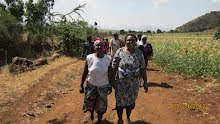
Angus, Susan and I surveyed seven of the 63 original members of the Muchui Womens Group today. These visits confirmed what we have been observing in the community since we arrived two weeks ago.
All seven of the women planted hybrid varieties of maize and all seven had either partial or total crop failure . This is because of the drought. The maize started growing well but before it elongated, it dried up. This is in spite of the fact that they had the ground worked ahead, planted the right varieties, used fertilizer and compost, and spaced the plants the right distance apart.
They also planted wheat and will get very little yield from it. We saw them harvesting the crop by hand or allowing their cows, goats and sheep into the fields to harvest the little that is left.
Their kitchen gardens are producing little or nothing. They are using their drip irrigation but the onions and the kales they have planted are totally dried up. We think that they do not have enough money to pay for piped water.
When plants in the kitchen garden do come through the ground, the birds swoop down and eat the seedlings. They don’t eat an entire tomato- they just take a bite of one and then take a bite out of the next one.
We are exploring the purchase of bird netting from a greenhouse supplier company- particularly for the vegetable gardens at schools. However it is expensive.......
Teresa Mellish
Feb 7, 2011
Monday, February 7, 2011

Sunday, February 6, 2011
Week 1 - Erika Kubik

My mother always said "good things come to those who wait" and that saying is perfect for this rotation. I have wanted to be a part of this rotation since first learning about it before I got into veterinary school so the one day delay in Charlottetown and 25 hour delay in Paris was nothing compared to the five years I have waited, especially since being selected to participate in the Small Dairy Holdership rotation in December of 2009.
Up to this point in my life I have never been outside of North America, so being in Africa is a long distance away. However despite being so far away there are several similaries between Kenya and Canada. These include from the perpective for veterinary medicine, mastitis, nutrition, and reproduction being important topics, money from the monertary perpective and family from the moral values side of things. It is all of these similarties that bring myself and Farmer's Helping Farmers to this beautiful country.
One of the ways Farmers Helping Farmers does this is through seminars, which are held not only when Dr. VanLeeuwan is here but also an employee who does talks throughout the year to answer any questions and to follow up on the advice given. All of the farmers from each of the dairies, whether it be Gakindu, Othaya or Ex-Lawa, are all very appreciative and inquisitive on the causes and prevention of diseases, such as tick-borne disease, retained placeta and mastitis.
I am very grateful to Farmers Helping Farmers for allowing me the opportunity to not only interact with such great people in such a fantastic place but also discuss and inform others on topics, I myself, find very interesting.
Week 1 - Erin Ramsay

Habari!
During our first week we stayed in a rural area of western Kenya called Ishiara. Almost immediately we met a lot of very interesting & fun people! Two final year veterinary students from the University of Nirobi named James and Ibriham. We had a lot of fun pooling our knowledge when working up cases we saw on local farms. We were able to compare notes about our vet school experience and from them we learned a few new Swahili words. Simon our driver is a pretty cool guy, he knows a lot about Kenya and rasing livestock. We were also lucky enough to travel with Steven a local agronomist. Wow! We met so many people I can't even mention them all.
From there we had the opportunity to participate in training sessions for members of the Ishiara, Mikinduri, and Oythya dairy groups. These days usually began with tea/coffee meet and greets at the dairy headquarters. Then we would move to a shamba were there could be anywhere from 50-100 farmers underneath the shade of a tree! It was really cool to see how responsive the crowds of farmers (men, women, and children) were to the knew facts about animal health, husbandry, and nutrition they were aquiring. It is clear that these farmers care very much for the health and productivity of their animals and are more than willing to make changes around their own shambas (farms).
After spending a week here I realize that I have underestimated the value and contribution of one or two cows to the lives of the people that care for them. After visiting the Wakulima Dairy Group we have heard so much about it is obvious that FHF has greatly improved life for the people in the community it services. I am very proud to be here and a part of team FHF.
Week 1 - Murray Gillies

Mother nature seemed to disapprove of our trip to Kenya, but finally after a storm cancellation in Charlottetown, a mechanical cancellation in Paris and a few hours worth of delays we arrived in Nairobi. Although we were 2 days late and lost a lot of time to delays and cancellations, it was well worth the time; and this has only been the first week! After a short nights sleep in Nairobi we departed on the long drive to Ischmara. The scenery was absolutely breathtaking! It is always changing and is never the same. Shadowed by the magnificent mount Kenya, the country stretches out in all four directions as completely different landscapes. All of which kept us wide-eyed as we drove to where we would be working first.
Working with the farmers and the animals here has been very rewarding. The farmers are incredibly nice and eager to learn anything that you may have to teach them. From diagnosing and treating individual animals to teaching at seminars put on by the different dairies, it fills oneself with a great sence of pride at being able to teach, knowing it does make a difference and seeing how grateful the farmers are that you were willing to help them out. I can only imagine the next 2 weeks will be even better than the first, which was already amazing!
Composting A Success Story
Susan MacKinnon
In 2010, Winston Johnston and I introduced the Ruuju and Muchui Women’s groups to composting. The composting process allows the women to convert locally available plant materials, manure and wood ash into a valuable soil amendment that can be use alone or in conjunction with their commercial fertilizer. Good quality compost can be made in this climate in 2 -3 months.
The training was definitely well received. As Angus Mellish and I visited farms this past two weeks in Ruuju and Muchui we saw compost piles at nearly all the farms. It was exciting to hear that many of the Ruuju women did not have to purchase starter fertilizer for this years maize crop because they had made sufficient compost. If the look of their maize crop is any indication I expect that the women will continue making and using compost in the future.
In Muchui , a lot of the women used their compost in their kitchen gardens and on vegetable crops they plan to sell. It is really interesting listening to the women describe how they modified the recipe to fit the range of inputs they have available on their farms. The women are now making more compost in preparation for the next rainy season. Hopefully the rains come.
In 2010, Winston Johnston and I introduced the Ruuju and Muchui Women’s groups to composting. The composting process allows the women to convert locally available plant materials, manure and wood ash into a valuable soil amendment that can be use alone or in conjunction with their commercial fertilizer. Good quality compost can be made in this climate in 2 -3 months.
The training was definitely well received. As Angus Mellish and I visited farms this past two weeks in Ruuju and Muchui we saw compost piles at nearly all the farms. It was exciting to hear that many of the Ruuju women did not have to purchase starter fertilizer for this years maize crop because they had made sufficient compost. If the look of their maize crop is any indication I expect that the women will continue making and using compost in the future.
In Muchui , a lot of the women used their compost in their kitchen gardens and on vegetable crops they plan to sell. It is really interesting listening to the women describe how they modified the recipe to fit the range of inputs they have available on their farms. The women are now making more compost in preparation for the next rainy season. Hopefully the rains come.
Sweet potatoes

When the UPEI nutrition students visited the Meru area last summer they identified that the diet of many people is deficient in Vitamin A. Vitamin A is very important for vision, immunity from disease and healthy skin. It is especially important for young children to prevent night blindness.
Orange sweet potatoes are a very good source of vitamin A, one small one will meet a persons’ daily needs. Kenyan farmers grow sweet potatoes, but they are white and not high in vitamin A.
Susan MacKinnon and I did presentations to both the Ruuju and Muchui Womens groups about the benefits of orange sweet potatoes and how to grow them. We also purchased some orange sweet potatoes in Nairobi and cooked them for the women so that they could try them.
We have made arrangements for both groups to get slips of orange sweet potatoes to plant during the next rains.
Angus Mellish
School lunch feeding programs

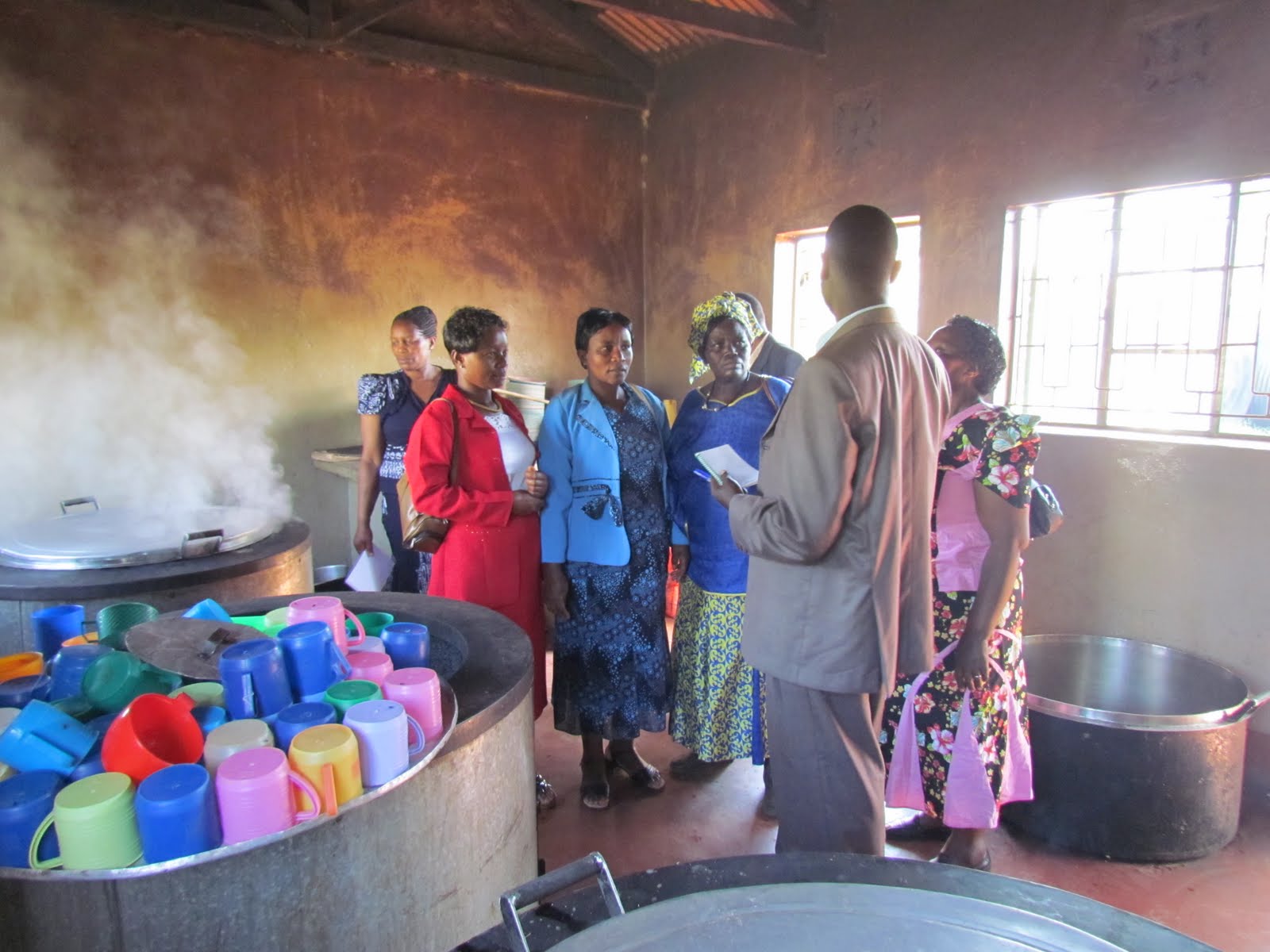
School representatives from four twinned schools in the Mukurwe-ini area, namely Gikondi, Mutwewathi, Ithanji, and Matuto Primary schools, were invited to visit the school feeding programs in three Meru area twinned schools, Kinyenjere Primary, Ruuju Primary, and Ndunyu Secondary School on Tuesday, Feb 2nd and 3rd, 2011. The group consisted of the coordinator of the Wakulima Dairy, one Wakulima director, three head teachers, two twinning teachers, and two parent members of school management committees.
The objective of this visit was to give the Mukurwe-ini group an opportunity to see first-hand how these three Meru area schools were able to provide both uji, a maize-based porridge, at break and githeri, maize and beans, at lunch.
None of the twinned schools in the Mukurwe-ini area currently has a school feeding program.
The nine people attending visited the school gardens, saw drip irrigation systems, screen/green houses and admired three of the four school cookhouses which have enabled over 1000 children to be ensured food on a daily basis. Two of these cookhouses were built as a result of the Souris Village Feast.
The group were very excited about the possibilities they saw for their schools and learned a great deal! FHF is hoping that these schools will engage their school communities to initiate feeding programs in the Mukurwe-ini area.
Subscribe to:
Posts (Atom)