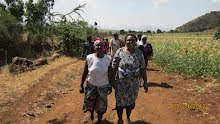
two weeks in and my g.p.s. is finally settling down!it has been a period of everything being new, different and totally without context.kind of like taking your g.p.s. through the round about three times!you are in an unverified area, turn around whenever possible.we have seen poverty and prosperity, considerably more of the former.some of the sights that truly overwhelmed me with with sadness,the slums of nairobi,the reality of seeing subsistence farming and the children.
my work with greenhouses and farmers goes well. it is a learning spike!,but the more i learn ,the more i can contribute.we have two grafting chambers in place and have done some grafting with two of the kenyan extensionists.conditions are not perfect but a sustained effort should leave them with the ability to graft tomatoes.
the team effort is quite remarkable,many people rushing wildly in all directions at once,each with their own agenda.sorry can not send more ,typing is not my fortè and my air-time is expiring. god bless, charlie vankampen
Saturday, February 4, 2012

Monday, January 30, 2012
FHF AVC Student blog
First week in Kenya!!! After landing in Nairobi Airport last Saturday evening, and after clearing customs, we (Dr. Fabienne, Lloyd, Teresa, Marissa and Mel) were greeted by Henry Macharia of Sportsmen’s Safaris & Tours Ltd. After introductions and a quick round of hugs and handshakes, we set out to see whose luggage had arrived and whose had been lost…
Following this, we met our driver for the next 3 weeks (David) and set out for the hotel! I had had my doubts about how much sleep I would get our first night, but the second my head hit the pillow I was out like a toddler after his first day in Disneyland. The next day, our first farm visit in Kenya was to a Simmental herd in rural Kenya. It was here that I got my first glimpse of Kenya’s sheer, untamed beauty. From rolling hills, to lush forests, everywhere I looked there was something brand new and amazing! While on the ranch, we were lucky enough to snap some pictures of zebras, giraffes, ostriches, and of course, some BEAUTIFUL Simmental cattle. The next day, the FHF group took a quick trip to the Canadian High Commission to check in with the head of CIDA before splitting off into our respective groups. Our travels took us to Mukurwe-ini where we set up shop for the first week and the Ichamara house. After settling in, we were treated to the awesome cooking from Francis, our chef.
Our day-to-day ‘routine’ for the first week has been pretty interesting. Our days usually begin with a trip to the Wakulima Dairy before hitting the road and visiting various dairy farms, or ‘shambas’. When we’re not working with cattle, our time is usually spent in seminars with 30-75 of the local small-holder dairy farmers. These seminars function as a way of getting the farmers together in one place and allow them to voice any and all questions they have regarding nutrition, calf management, or reducing mastitis (an infection of the cow’s mammary gland). As a student, we are expected to participate and field certain questions during the seminar, which was a little stressful at first, but as time went on we all seemed to become more comfortable with answering questions.
So that’s our first week in a nutshell! Next week, we’re off to Meru for a walk-in deworming/ sick-cow clinic on Sunday followed by visits to various dairy groups and seminars.
This is Russ Campbell, signing off.
Following this, we met our driver for the next 3 weeks (David) and set out for the hotel! I had had my doubts about how much sleep I would get our first night, but the second my head hit the pillow I was out like a toddler after his first day in Disneyland. The next day, our first farm visit in Kenya was to a Simmental herd in rural Kenya. It was here that I got my first glimpse of Kenya’s sheer, untamed beauty. From rolling hills, to lush forests, everywhere I looked there was something brand new and amazing! While on the ranch, we were lucky enough to snap some pictures of zebras, giraffes, ostriches, and of course, some BEAUTIFUL Simmental cattle. The next day, the FHF group took a quick trip to the Canadian High Commission to check in with the head of CIDA before splitting off into our respective groups. Our travels took us to Mukurwe-ini where we set up shop for the first week and the Ichamara house. After settling in, we were treated to the awesome cooking from Francis, our chef.
Our day-to-day ‘routine’ for the first week has been pretty interesting. Our days usually begin with a trip to the Wakulima Dairy before hitting the road and visiting various dairy farms, or ‘shambas’. When we’re not working with cattle, our time is usually spent in seminars with 30-75 of the local small-holder dairy farmers. These seminars function as a way of getting the farmers together in one place and allow them to voice any and all questions they have regarding nutrition, calf management, or reducing mastitis (an infection of the cow’s mammary gland). As a student, we are expected to participate and field certain questions during the seminar, which was a little stressful at first, but as time went on we all seemed to become more comfortable with answering questions.
So that’s our first week in a nutshell! Next week, we’re off to Meru for a walk-in deworming/ sick-cow clinic on Sunday followed by visits to various dairy groups and seminars.
This is Russ Campbell, signing off.
Wednesday, November 23, 2011
Victoria's and Evelynn's watertanks

Imagine my surprise yesterday when I saw Victoria's and Evelynn's water tank yesterday. We were on Margaret Muriuki's farm where we were assessing the practical skills of the applicants for the horticulturist position. She has one of the PHFAMS greenhouses which has tomatoes which have just started production.
Inflation in Kenya
Inflation in Kenya is reaching 19%, according to Jennifer Murogocho and Shaad Olingo.
They tell me about the price of petrol which has gone up from 85 shillings per litre at the beginning of the year to 125 shillings per litre today. The price of a tank of cooking gas has gone from 2150 to 3900 shillings.
The price of cooking fat has gone from 120 to 260 shillings.
The price of 2 kg of sugar has gone 160 to 375 shillings for a 2 kg packet.
Shaad says everything has gone up- especially the prices of spare parts for vehicles. He says that most people just drive their vehicles when they have to.
But farmers can still expect prices to go down when their crops are harvested. All of Kenya has received a lot of rain and everyone expects a good harvest.
They tell me about the price of petrol which has gone up from 85 shillings per litre at the beginning of the year to 125 shillings per litre today. The price of a tank of cooking gas has gone from 2150 to 3900 shillings.
The price of cooking fat has gone from 120 to 260 shillings.
The price of 2 kg of sugar has gone 160 to 375 shillings for a 2 kg packet.
Shaad says everything has gone up- especially the prices of spare parts for vehicles. He says that most people just drive their vehicles when they have to.
But farmers can still expect prices to go down when their crops are harvested. All of Kenya has received a lot of rain and everyone expects a good harvest.
Sunday, November 20, 2011
Getting stuck on the way back from Kamuketha School


Shaad Olingo and I visited the Kamuketha Primary School yesterday.
The road was difficult to drive over because of the damages from the rain during the past month.
After we had a good visit with the head teacher at the school, the skies started to darken and Shaad said we should get going back to the Mbaaria Market because he expected rain.
We no sooner got into the Gypsy than it started to rain hard.
We got about 500 metres for the school when we stopped- and Shaad tried to get to the upper side of a low spot on the road. However the Gypsy couldn’t make it to the upper side. We tried many times to get out- until we were crossways on the road with the rear tires in the low trench.
Meanwhile it was raining harder and harder and Shaad conceded that we were stuck.
Shaad decided to telephone for help- but there was no network on Shaad’s telephone- and I searched in my bag for my Kenyan phone. It wasn’t there- but my Canadian phone was in a zippered pocket where I had put it away.
In desperation I tried to call Jennifer on my Canadian phone- which showed two bars of network. It worked- and her voice was very clear. We asked her to call the Kamuketha head teacher so he could help us. He then called us back and promised to help.
The head teacher came with more than a dozen boys and a Kenyan hand plaited rope. They hooked the rope under the bumper and pulled the car out of the trench up to the high ground. (The Gypsy is quite light).
The boys escorted us until it was obvious to them that we would not get stuck again. The head teacher got into the back of the Gypsy and travelled with us to Kinyinjere. He helped again when we encountered an ox cart which was stuck- the wheels on one side were in a trench and his oxen would not pull together to get it out.
This was not nearly as traumatic as when Karl Winter and I got stuck in this area during the El Ninya rains. Then there was a foot of water on the road and you could not see the trenches.
But it made for an interesting safari.
Teresa
Tuesday, September 13, 2011
Safari Njema!


Written by Danaiet Teame, Gloria Smith and Danielle McConnell
We started off our last week in Kiiura and at St. Teresa’s with our third and final presentation to hospital staff. This presentation included a summary of our internship where we shared our favorite moments and some of our learning experiences. We ended the presentation with recommendations for the hospital based on our work there as requested by the sisters. Our original presentation was on Monday morning, however we repeated it on Thursday afternoon so that all hospital staff were able to be present and anyone who wasn’t able to come Monday had the opportunity to hear what we had to share.
On Tuesday our original plan was to visit Ruju school to complete the last of our school presentations, however there is currently a teacher’s strike occurring in Kenya and school did not commence like it was supposed to. That left us with time to make some home visits to clients from the HIV support group mentioned in the last blog that were to receive a goat. We set out on a goat mission and were able to purchase and deliver 4 of the 6 goats to the clients’ homes. They were all very grateful and the home visits allowed us to met some of their family members who will also benefit from a goat.
Wednesday’s have been our favorite day throughout the summer because they are always a big surgery day when all the main surgeries for the week are taking place. Each Wednesday we have been assisting in the theater and have come to love working there. The theater is also where a lot of our learning took place over the summer because the doctors and nurses were great teachers. We were sad that Wednesday was our last day working there and thanked the staff by bringing some Canadian baking goods to show our appreciation.
We also made some other Canadian dishes that we shared with our friends, the sisters and hospital staff on Thursday after our presentation. We gathered in the guesthouse with our company to share one of our last evenings together and say our goodbyes. We can’t believe that 90 days has come and gone so fast and it is the time for our friends and colleagues to say ‘Safari njema’ (safe journey) and send us on our way. We are sad to say goodbye to our new friends, not knowing when we will see each other again, but we know that our work here is not finished and that their kindness will never be forgotten. One wise Daktari left us with these words:
“Go forth into the world in peace and of good courage
Strengthen the weak and faint-hearted
Render to no man evil for evil
and may the presence of god be with us
His power enables you peace with god assure today and always.”
We will miss you Kiirua!
Tuesday, September 6, 2011
HIV Support Group

By Danaiet Teame, Gloria Smith and Danielle McConnell
This month we had the opportunity to join in on a HIV support group meeting at the CCC clinic at St. Theresa’s hospital. The HIV support group was established in 2008 and has had up to 62 members but numbers have been dwindling over the past few years. The day we attended the meeting there were 30 clients that travelled from up to an hour away, however the month previous, there were only 18 members present. We did a presentation to the group about HIV transmission, prevention, and HIV in pregnancy. The clients had a lot of questions about their weight and how to know what is a healthy weight so we ran back to the guesthouse and brought back our scale, measuring tape and calculator. We took each client’s measurements and calculated their BMI and taught them what it meant. We also took the opportunity to record the results. There were 6 clients with BMI’s below 18.5 indicating underweight nutritional status.
The hospital receives fortified flour from USAID for client’s who are HIV positive with a BMI under 16, which indicates severe malnutrition. However, none of the clients at this time qualified for this supplementation, despite their poor nutritional status. Thanks to the support of the UPEI School of Nursing, each member at the meeting received a bag of maize flour and a bunch of fresh kale as well as lunch (ugali and gtheri) with tea. Two weeks later, some of the members who are struggling to have enough food received maize and beans. We also discovered that the money donated by UPEI school of Nursing helps pay for medication fees of clients who come in to the hospital with opportunistic infections as well as supply the HIV testing kits.
After several weeks of doing HIV outreach in 4 different communities, doing home visits, and spending time in St. Theresa’s Comprehensive Care Clinic (CCC) we feel that the HIV support group has the potential to grow and be a beneficial resource in the community. We have envisioned the group becoming like the Muchuii or Ruuju women's groups. We would love to see the group be more than just an educational and psychosocial support group, but also help in assisting with sustainable living needs. If the group could help provide client's with nutritional, transportation, and perhaps employment needs, then this might attract more members that otherwise wouldn't come because of stigma, while improving the health of the clients, therefore increase the lifespan of the HIV positive client. Just as the Muchuii group employs some of the women, members could run the support group.
To gather more information and ideas for strengthening the support group at St. Theresa’s we visited the CCC at Meru General hospital. There are 5 different support groups based out of the clinic that meet every month and provide for the members in different ways, depending on their need. The 5 support groups consist of two groups for HIV positive clients, one group for HIV positive youth, a group for caregivers of HIV positive family members and a support group for hospital staff.
We were very impressed that there is such an interest in the support group at Meru that there are two different groups for HIV positive clients and that support is offered to such a wide population. We hope that someday there will be such participation and interest in the group at St. Theresa’s.
For now we have decided that the best way we are able to help the support group and it’s members is to assist the client’s with low BMI’s and nutritional status. The 6 members with low BMI’s have a poor nutritional status, however are not in enough need according to the USAID guidelines to be supported and recognized to receive nutritional supplements such as fortified flour. With money that was kindly donated from Winsole United Church we have arranged to buy goats for 6 members in the group with BMI’s under 18.5. Our time in Kiiura is coming to an end and we are hoping to purchase the goats and bring to their homes by the end of the week. In the past, students have purchase goats for clients in need and we believe these 6 clients’ will benefit from a food source that can be sustained over a long period of time.
Our hope of transforming the support group into a group similar to the Muchuii or Ruuju women’s groups is something that we realize cannot happen over night. We have purchased bags made at Machaka Orphanage to bring home to Canada to sell in order to raise more money to support the group and we hope that with the help of UPEI and Farmer’s Helping Farmer’s we can continue to work towards establishing more resources for the support group at St. Theresa’s Hospital.
Subscribe to:
Posts (Atom)