Saturday, February 4, 2012

Screenhouse kitchen gardens producing vegetables for home consumption and for sale


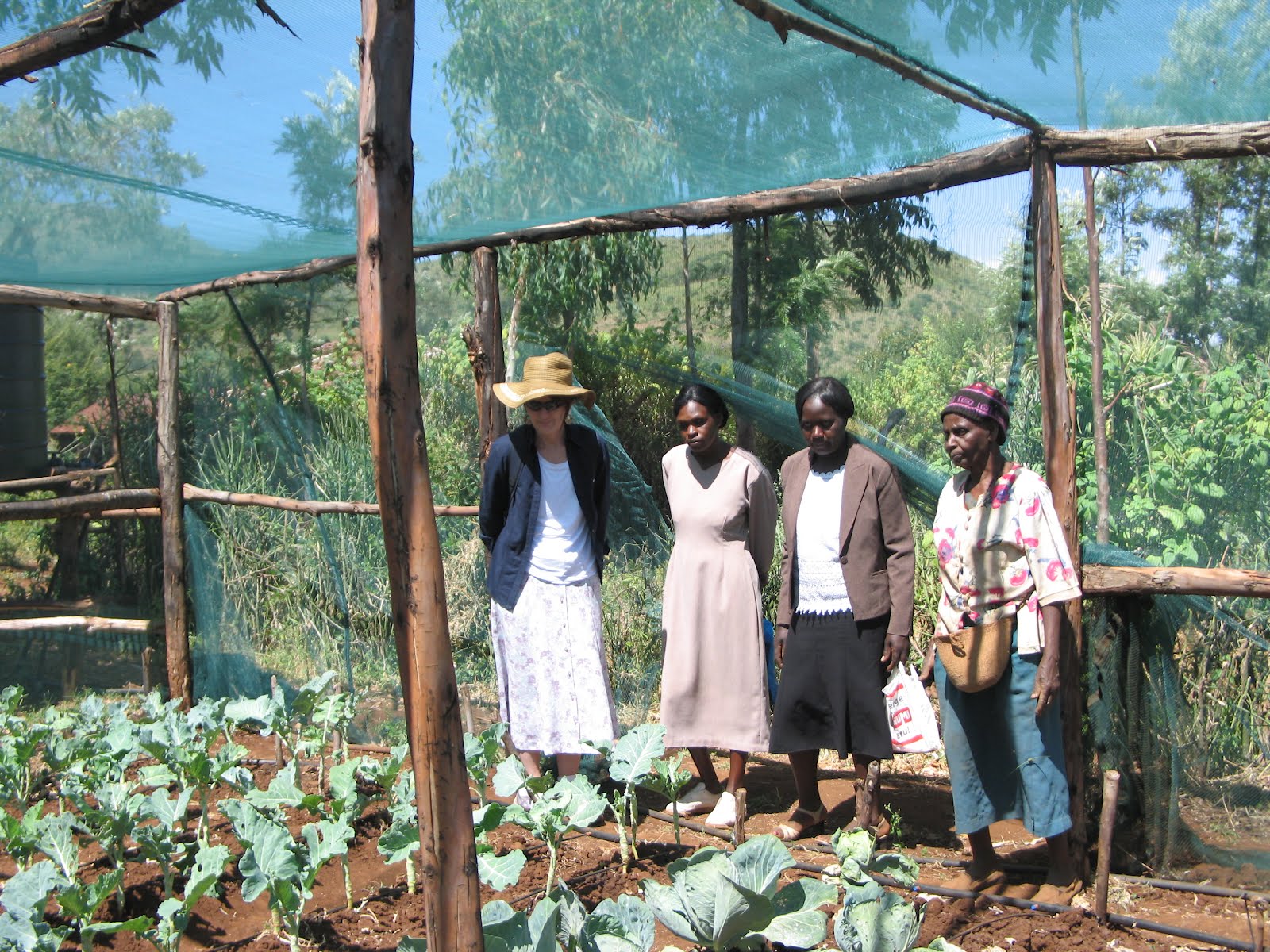
We've been visitng the 70 kitchen gardens being operated by the members of the Muchui Womens Group- in which the women are producing vegetables for domestic consumption and for sale


One of the Muchui members (right) discusses her garden with Rosemary Herbert and two of the Muchui Directors


Charlie van Kampen, Stephen Mwenda, Margie Loo and Festus Nkuru discuss the vegetables gardens


Many of the screenhouses have been producing vegetables for sale since early December. The women are very pleased withthe screenhouses. We are proud to be associated with the Andreas Baur Foundation for this initiative.

Business Planning with Muchui Womens Group : a work in progress

Grace Muruiki, the new Chairperson of Muchui Womens Group, chaired the business development seminar


Esther Kigunda works on developing the vision statement


I met with the Muchui Womens Group on Wednesday and Thursday this past week to develop a business plan. Duncan Muya, the General Manager of the Mukuurwe-ini Wakulima Dairy Ltd worked with me to facilitate the development of the plan. We are training the women on how to develop a business plan as we develop the plan.
What a dynamic group of women they are to work with! They participate to the fullest extent. We started this process in November and since then they gathered information on the financial side of their six enterprises.
We have a good draft of the Vision Statement prepared for the Muchui Womens Group:
“To be a dynamic group of business women producing high value crops in dryland that competes in local and international markets so as to increase income and ensure food security for members and community”

We will continue to work with them next week to develop a good draft of the plan.
Teresa Mellish

unverified area!

two weeks in and my g.p.s. is finally settling down!it has been a period of everything being new, different and totally without context.kind of like taking your g.p.s. through the round about three times!you are in an unverified area, turn around whenever possible.we have seen poverty and prosperity, considerably more of the former.some of the sights that truly overwhelmed me with with sadness,the slums of nairobi,the reality of seeing subsistence farming and the children.
my work with greenhouses and farmers goes well. it is a learning spike!,but the more i learn ,the more i can contribute.we have two grafting chambers in place and have done some grafting with two of the kenyan extensionists.conditions are not perfect but a sustained effort should leave them with the ability to graft tomatoes.
the team effort is quite remarkable,many people rushing wildly in all directions at once,each with their own agenda.sorry can not send more ,typing is not my fortè and my air-time is expiring. god bless, charlie vankampen

Monday, January 30, 2012

FHF AVC Student blog

First week in Kenya!!! After landing in Nairobi Airport last Saturday evening, and after clearing customs, we (Dr. Fabienne, Lloyd, Teresa, Marissa and Mel) were greeted by Henry Macharia of Sportsmen’s Safaris & Tours Ltd. After introductions and a quick round of hugs and handshakes, we set out to see whose luggage had arrived and whose had been lost…
Following this, we met our driver for the next 3 weeks (David) and set out for the hotel! I had had my doubts about how much sleep I would get our first night, but the second my head hit the pillow I was out like a toddler after his first day in Disneyland. The next day, our first farm visit in Kenya was to a Simmental herd in rural Kenya. It was here that I got my first glimpse of Kenya’s sheer, untamed beauty. From rolling hills, to lush forests, everywhere I looked there was something brand new and amazing! While on the ranch, we were lucky enough to snap some pictures of zebras, giraffes, ostriches, and of course, some BEAUTIFUL Simmental cattle. The next day, the FHF group took a quick trip to the Canadian High Commission to check in with the head of CIDA before splitting off into our respective groups. Our travels took us to Mukurwe-ini where we set up shop for the first week and the Ichamara house. After settling in, we were treated to the awesome cooking from Francis, our chef.
Our day-to-day ‘routine’ for the first week has been pretty interesting. Our days usually begin with a trip to the Wakulima Dairy before hitting the road and visiting various dairy farms, or ‘shambas’. When we’re not working with cattle, our time is usually spent in seminars with 30-75 of the local small-holder dairy farmers. These seminars function as a way of getting the farmers together in one place and allow them to voice any and all questions they have regarding nutrition, calf management, or reducing mastitis (an infection of the cow’s mammary gland). As a student, we are expected to participate and field certain questions during the seminar, which was a little stressful at first, but as time went on we all seemed to become more comfortable with answering questions.
So that’s our first week in a nutshell! Next week, we’re off to Meru for a walk-in deworming/ sick-cow clinic on Sunday followed by visits to various dairy groups and seminars.
This is Russ Campbell, signing off.

Wednesday, November 23, 2011

Victoria's and Evelynn's watertanks


Imagine my surprise yesterday when I saw Victoria's and Evelynn's water tank yesterday. We were on Margaret Muriuki's farm where we were assessing the practical skills of the applicants for the horticulturist position. She has one of the PHFAMS greenhouses which has tomatoes which have just started production.

Inflation in Kenya

Inflation in Kenya is reaching 19%, according to Jennifer Murogocho and Shaad Olingo.
They tell me about the price of petrol which has gone up from 85 shillings per litre at the beginning of the year to 125 shillings per litre today. The price of a tank of cooking gas has gone from 2150 to 3900 shillings.
The price of cooking fat has gone from 120 to 260 shillings.
The price of 2 kg of sugar has gone 160 to 375 shillings for a 2 kg packet.
Shaad says everything has gone up- especially the prices of spare parts for vehicles. He says that most people just drive their vehicles when they have to.
But farmers can still expect prices to go down when their crops are harvested. All of Kenya has received a lot of rain and everyone expects a good harvest.

Sunday, November 20, 2011

Getting stuck on the way back from Kamuketha School


Shaad Olingo and I visited the Kamuketha Primary School yesterday.
The road was difficult to drive over because of the damages from the rain during the past month.
After we had a good visit with the head teacher at the school, the skies started to darken and Shaad said we should get going back to the Mbaaria Market because he expected rain.
We no sooner got into the Gypsy than it started to rain hard.
We got about 500 metres for the school when we stopped- and Shaad tried to get to the upper side of a low spot on the road. However the Gypsy couldn’t make it to the upper side. We tried many times to get out- until we were crossways on the road with the rear tires in the low trench.
Meanwhile it was raining harder and harder and Shaad conceded that we were stuck.
Shaad decided to telephone for help- but there was no network on Shaad’s telephone- and I searched in my bag for my Kenyan phone. It wasn’t there- but my Canadian phone was in a zippered pocket where I had put it away.
In desperation I tried to call Jennifer on my Canadian phone- which showed two bars of network. It worked- and her voice was very clear. We asked her to call the Kamuketha head teacher so he could help us. He then called us back and promised to help.
The head teacher came with more than a dozen boys and a Kenyan hand plaited rope. They hooked the rope under the bumper and pulled the car out of the trench up to the high ground. (The Gypsy is quite light).
The boys escorted us until it was obvious to them that we would not get stuck again. The head teacher got into the back of the Gypsy and travelled with us to Kinyinjere. He helped again when we encountered an ox cart which was stuck- the wheels on one side were in a trench and his oxen would not pull together to get it out.
This was not nearly as traumatic as when Karl Winter and I got stuck in this area during the El Ninya rains. Then there was a foot of water on the road and you could not see the trenches.
But it made for an interesting safari.
Teresa