Posted by Rosemary Herbert (Farmers Helping Farmers Board Member and Faculty Member UPEI School of Nursing).
Today is the beginning of our third week in Kenya. Time is flying by – every day is very full with so much to learn and do.
I have had the pleasure of visiting primary and secondary schools. I will visit a total of eight schools. The children are so excited to have visitors and to receive letters and funds from their friends at twin schools in Prince Edward Island.
The children are delightful. They appear happy, healthy and very pleased to welcome visitors to their school. Sometimes they sing to welcome us or repeat their class mottos. I often have the privilege of visiting each classroom and speaking to the students.
During my visits, I interview each headteacher or other senior teachers about the health issues of the children. All are extremely appreciative of the help provided by FHF and ask me to convey their deep gratitude to FHF supporters.
I am so impressed by what has been accomplished. FHF dedication signs are a natural part of the landscape of the twinned schools in Kiirua and Marega. The children lineup twice a day at the cookhouse–during the morning for uji- and at lunchtime for githeri. School gardens and sometimes screenhouses are used to grow food for the children. The two meals provided at school are the main source of food for many of the children. Week-ends are a hungry time for many. Cookhouses, water tanks, school gardens,screenhouses, classrooms, milk, and learning resources have all been provided by FHF.
So much has been done yet there is more that we can do to improve the health of the children. Providing all of the twinned schools with cookhouses and gardens will greatly contribute to ensuring children are adequately nourished and better able to learn. Distributing mosquito nets to school children is critical for preventing malaria, a very common illness in many schools. Regular deworming programs would help prevent frequent worm infestations in the children.
Visiting Kenya has made me realize how much can be accomplished by such a few people.The cookhouses provided by the Village Feast have made a huge impact on the health of schoolchildren as have the other contributions by FHF.It is a humbling experience to hear the gratitude and see the positive results in the children.
Sunday, February 5, 2012

Saturday, February 4, 2012
my second week in Kenya


This is Saturday. We have been here for two weeks. The first week went slowly, with everything being new and unfamiliar. This week went faster and I am certain the last week will just whiz by. At the moment I am sitting in front of my tent in a private game park watching gazelles, zebras and ward hogs wander past on their way to a watering hole. Mount Kenya is on the horizon but it is too hazy to see the glacier on its side. Birds are calling. The breeze is stirring the air so that it is warm but not hot. The world is alive with the magic of life.
I have been trying to learn to say a few things in Swahili, the challenge is that Swahili is the common National language but there are also 42 local languages. People flip back and forth between Kikuyu and Swahili in this part of Kenya. I can now greet people politely in both languages and say thank you. After that words float around in my head and I try to remember which belong to which language and rarely bring the right one out at the right time.
I visited many gardens through the week, some on the back of a motorcycle some on foot. The sun is hot but even though we are on the equator the air is cool in the shade. Everything is very dry. There were terribly heavy, deadly rains in December but there hasn’t been a proper rainy season for the last two years. The rainy season should be starting in March and that is what hope is hinged on now. The women’s groups that are working with Farmers Helping Farmers are better off than others because most of them have gotten piped water from Mount Kenya’s glacier and FHF has supplied them with a water tanks to collect rain water so that they can water their animals and gardens. Even those lucky enough to have piped water and drip lines have trouble keeping their gardens growing though. The sun and wind dries the soil out very quickly.
It is true that I come with fresh eyes and notice things that could be done differently and perhaps make life easier. There are however serious consequences to encouraging people to change their practices, especially before taking the time to understand why they do things the way they do. When you live on the edge and every cent you make is committed before it gets into your hand, mistakes matter. It would be great to be able to stay for a while and really understand how things work before having to plunge in, but I don’t have that kind of time. So I am trying to suggest changes that will not be risky.
As an example it would seem that mulch would be help with water retention in garden plots. The women have tried mulch before and found that it encouraged ants. I suspect this was because the soil was dry and if they mulch the beds with drip lines the ants will be less inclined to move in. So I have been working on sourcing some UV protected plastic like what I use at home. I am only getting a small amount and helping to set up a trial. If it turns out that the mulch decreases the amount of water needed, reduces plant stress and keeps the beds wet enough that the ants don’t like it then the women will be encouraged to try the plastic mulch in their own gardens.
Next week my work will be a bit different. I will be doing workshops on crop rotations and composting. They all make compost but there are layers of knowledge and I hope I can give them some deeper understanding of how to make good compost. They all know that they should be rotating crops too but the finer points are a bit vague, such as which vegetables belong in which families and which crops should follow which crops.
But today I am in a beautiful natural area with incredible wildlife around every corner and over every hill; from the cheetah we saw last evening to the rhinosaurus we saw this morning. If I forget for a minute that I am standing in a safari van with binoculars I can almost sense the origins of our species and imagine how it was that we learned to walk on two legs and carry spears. Then I am captured by the moment held spellbound by the beauty of the animals and the landscape.
From a distant place that is also somehow familiar,
Margie
Mangoes are in season

Mangoes are in season here in Kenya- and we eat them almost every day.
This tree is at the Ruuju Primary School and Ken will be delighted to see it in production. It will provide fruit for the school children.
Teresa
Screenhouse kitchen gardens producing vegetables for home consumption and for sale

We've been visitng the 70 kitchen gardens being operated by the members of the Muchui Womens Group- in which the women are producing vegetables for domestic consumption and for sale
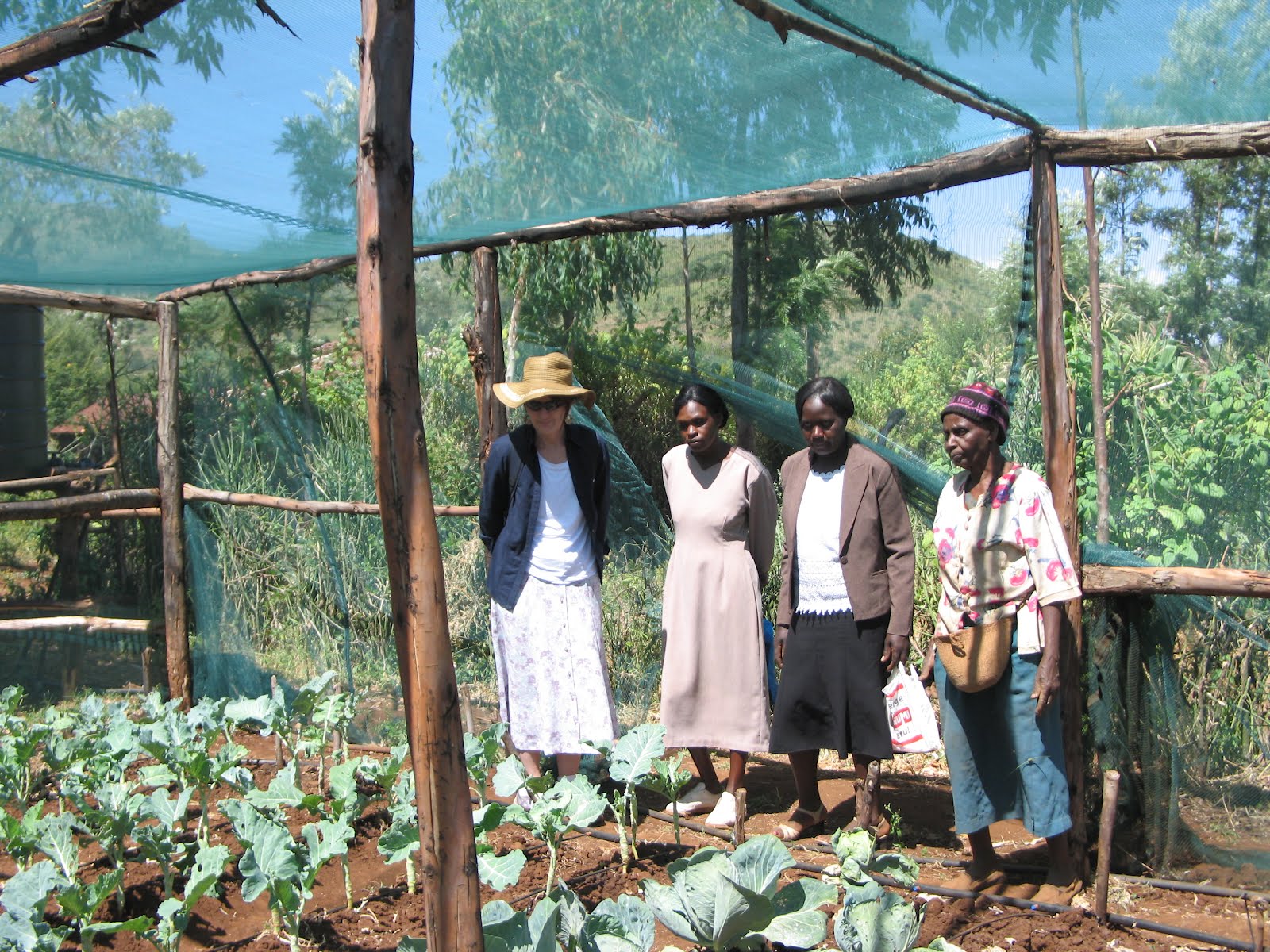
One of the Muchui members (right) discusses her garden with Rosemary Herbert and two of the Muchui Directors

Charlie van Kampen, Stephen Mwenda, Margie Loo and Festus Nkuru discuss the vegetables gardens
Many of the screenhouses have been producing vegetables for sale since early December. The women are very pleased withthe screenhouses. We are proud to be associated with the Andreas Baur Foundation for this initiative.
Business Planning with Muchui Womens Group : a work in progress
 Grace Muruiki, the new Chairperson of Muchui Womens Group, chaired the business development seminar
Esther Kigunda works on developing the vision statement
I met with the Muchui Womens Group on Wednesday and Thursday this past week to develop a business plan. Duncan Muya, the General Manager of the Mukuurwe-ini Wakulima Dairy Ltd worked with me to facilitate the development of the plan. We are training the women on how to develop a business plan as we develop the plan.
What a dynamic group of women they are to work with! They participate to the fullest extent. We started this process in November and since then they gathered information on the financial side of their six enterprises.
We have a good draft of the Vision Statement prepared for the Muchui Womens Group:
“To be a dynamic group of business women producing high value crops in dryland that competes in local and international markets so as to increase income and ensure food security for members and community”
We will continue to work with them next week to develop a good draft of the plan.
Teresa Mellish
unverified area!
two weeks in and my g.p.s. is finally settling down!it has been a period of everything being new, different and totally without context.kind of like taking your g.p.s. through the round about three times!you are in an unverified area, turn around whenever possible.we have seen poverty and prosperity, considerably more of the former.some of the sights that truly overwhelmed me with with sadness,the slums of nairobi,the reality of seeing subsistence farming and the children.
my work with greenhouses and farmers goes well. it is a learning spike!,but the more i learn ,the more i can contribute.we have two grafting chambers in place and have done some grafting with two of the kenyan extensionists.conditions are not perfect but a sustained effort should leave them with the ability to graft tomatoes.
the team effort is quite remarkable,many people rushing wildly in all directions at once,each with their own agenda.sorry can not send more ,typing is not my fortè and my air-time is expiring. god bless, charlie vankampen
my work with greenhouses and farmers goes well. it is a learning spike!,but the more i learn ,the more i can contribute.we have two grafting chambers in place and have done some grafting with two of the kenyan extensionists.conditions are not perfect but a sustained effort should leave them with the ability to graft tomatoes.
the team effort is quite remarkable,many people rushing wildly in all directions at once,each with their own agenda.sorry can not send more ,typing is not my fortè and my air-time is expiring. god bless, charlie vankampen
Monday, January 30, 2012
FHF AVC Student blog
First week in Kenya!!! After landing in Nairobi Airport last Saturday evening, and after clearing customs, we (Dr. Fabienne, Lloyd, Teresa, Marissa and Mel) were greeted by Henry Macharia of Sportsmen’s Safaris & Tours Ltd. After introductions and a quick round of hugs and handshakes, we set out to see whose luggage had arrived and whose had been lost…
Following this, we met our driver for the next 3 weeks (David) and set out for the hotel! I had had my doubts about how much sleep I would get our first night, but the second my head hit the pillow I was out like a toddler after his first day in Disneyland. The next day, our first farm visit in Kenya was to a Simmental herd in rural Kenya. It was here that I got my first glimpse of Kenya’s sheer, untamed beauty. From rolling hills, to lush forests, everywhere I looked there was something brand new and amazing! While on the ranch, we were lucky enough to snap some pictures of zebras, giraffes, ostriches, and of course, some BEAUTIFUL Simmental cattle. The next day, the FHF group took a quick trip to the Canadian High Commission to check in with the head of CIDA before splitting off into our respective groups. Our travels took us to Mukurwe-ini where we set up shop for the first week and the Ichamara house. After settling in, we were treated to the awesome cooking from Francis, our chef.
Our day-to-day ‘routine’ for the first week has been pretty interesting. Our days usually begin with a trip to the Wakulima Dairy before hitting the road and visiting various dairy farms, or ‘shambas’. When we’re not working with cattle, our time is usually spent in seminars with 30-75 of the local small-holder dairy farmers. These seminars function as a way of getting the farmers together in one place and allow them to voice any and all questions they have regarding nutrition, calf management, or reducing mastitis (an infection of the cow’s mammary gland). As a student, we are expected to participate and field certain questions during the seminar, which was a little stressful at first, but as time went on we all seemed to become more comfortable with answering questions.
So that’s our first week in a nutshell! Next week, we’re off to Meru for a walk-in deworming/ sick-cow clinic on Sunday followed by visits to various dairy groups and seminars.
This is Russ Campbell, signing off.
Following this, we met our driver for the next 3 weeks (David) and set out for the hotel! I had had my doubts about how much sleep I would get our first night, but the second my head hit the pillow I was out like a toddler after his first day in Disneyland. The next day, our first farm visit in Kenya was to a Simmental herd in rural Kenya. It was here that I got my first glimpse of Kenya’s sheer, untamed beauty. From rolling hills, to lush forests, everywhere I looked there was something brand new and amazing! While on the ranch, we were lucky enough to snap some pictures of zebras, giraffes, ostriches, and of course, some BEAUTIFUL Simmental cattle. The next day, the FHF group took a quick trip to the Canadian High Commission to check in with the head of CIDA before splitting off into our respective groups. Our travels took us to Mukurwe-ini where we set up shop for the first week and the Ichamara house. After settling in, we were treated to the awesome cooking from Francis, our chef.
Our day-to-day ‘routine’ for the first week has been pretty interesting. Our days usually begin with a trip to the Wakulima Dairy before hitting the road and visiting various dairy farms, or ‘shambas’. When we’re not working with cattle, our time is usually spent in seminars with 30-75 of the local small-holder dairy farmers. These seminars function as a way of getting the farmers together in one place and allow them to voice any and all questions they have regarding nutrition, calf management, or reducing mastitis (an infection of the cow’s mammary gland). As a student, we are expected to participate and field certain questions during the seminar, which was a little stressful at first, but as time went on we all seemed to become more comfortable with answering questions.
So that’s our first week in a nutshell! Next week, we’re off to Meru for a walk-in deworming/ sick-cow clinic on Sunday followed by visits to various dairy groups and seminars.
This is Russ Campbell, signing off.
Subscribe to:
Posts (Atom)