Thursday, May 15, 2008

UPEI Interns will travel to Kenya in June for 3 months

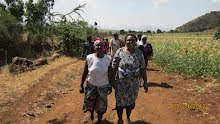
Four UPEI interns will spend June, July and August working on Farmers Helping Farmers projects in Kenya. Two interns will work with and teach the community members how to set up a bookkeeping system to help track their profits and expenditures and the other two interns will work with the communities to assess the diet of the children, identify the key deficiencies, and advise on diet changes, including which crops to grow.The two bookkeeping interns are Billy MacDonald and Bobby Cameron; the two nutrition interns are Doreen Pippy and Sharla Goodwin. They will be accompanied by Teresa Mellish and Colleen Walton for the first three weeks. This photo shows Billy MacDonald (left) with Bobby Cameron and Dr. John van Leeuwen, President of Farmers Helping Farmers.

Tuesday, April 29, 2008


Carolyn Francis, co ordinator of our latest public engagement project, Engaging Island Communities in Global Development and Patsy Dingwell, chair of the FHF education committee will be going to Kenya on May 30th. They will be there for three weeks visting the twinned schools. They will also visit potential schools in Mukuwe-ini and and Meru.
Check out our travels on this blog beginning early June!

Wednesday, November 21, 2007

FHF Intern Update - 10 days to go!


We visited 40 farms in Othaya last week and learned some important information that will help FHF members when they come in January. Some points I have noticed is that the milk production, per animal is on average lower then those in Wakulima. Also, only about ½ of the farmers we talked to use a teat dip after milking. Most of the farmers there feed napier grass and maize plants as the main staples of the animals diet. As well, dairy meal and pollard was fed at most farms.
This week we arrived in Embu to begin work on our final project for FHF. The Embu dairy has received funding for 50 biogas units. In preparation for the biogas, we are visiting the potential biogas farms to see how they cook now, etc. Biogas in Embu is rare, and most use firewood to cook with. Some use charcoal and paraffin. Everyone is excited about the prospect of biogas coming. Stephen and Faith, the FHF staff at Embu, are accompanying us around to each farm. They are very enthusiastic about the future of the dairy. Stephen noted that he was trying to convince some farmers in one area to grow maize as a crop for the cattle, but people in the area were very resistance to change and did not want to try anything new!
The three of us have noticed the difference in the farms and animals at the Othaya and Embu dairy, compared to those in Wakulima. The housing is especially different I found – in wakulima all farms have zero grazing units with a concrete base, while in Othaya and Embu they weren’t as common.
Today we are in Nairobi because Chelsea’s mom is coming for our last week here. We are picking her up at the airport and then heading back to Embu. Saturday we are planning a big ‘feast’ at our driver, Dominic’s house in Thika. He invited us for a dinner with his LARGE family (over 50). We are going to roast a goat and eat chapatti’s!! It will be quite the experience I’m sure!
That’s all for now - Cheers.


Julie Mutch

Saturday, November 10, 2007

Three weeks to go!


Well the last couple weeks have been very busy here in Kenya! We finished our work with the Wakulima Dairy and last week Dr. LaCroix , the dean of science at UPEI came to check up on us. As part of our internship with Students for Development, a representative from the University has to come see us! We toured him around the Dairy, went to see the biogas units, and interviewed those that will be receiving the biogas units. Dr. LaCroix also got to experience Kenyan tea ( half milk, half sugar, half tea !haha), and driving on the dirt roads when it is pouring rain!


One of the days was spent doing focus groups with farm women who ship milk to the Dairy. Dr. LaCroix accompanied us as well. We learnt SO much from them about the role the Dairy plays in their lives, why it is hard to get women to run for elected positions at the Dairy, as well as who makes the financial decisions in the family.


Here is the first group we talked to. They were all so helpful and had great responses to our questions.


At the end of the week we went on a safari to Samburu Game Park. We saw lots of elephants, zebras and giraffes, and we also saw two lions which was pretty neat.


After our safari we rode some camels.....that was fun! Except we were quite sore the next day!


On his last day here, we all went into Nairobi for a city tour. In the evening we went to the famous Carnivore Restaurant accompanied by our travel agent (whom many of you know), Henry. It was a great way to end the week!


The last few days, we have been in Mombasa for a mini-vacation! We got lots of sun and had an overall great time! The drive was long...7 hours each way but it was worth it!


Now we are into our final 3 weeks here in Kenya. Time has really flown by!


On Monday we are starting our work with the Othaya Dairy. We have between 30-50 farm visits to make. The information we are gathering will be used by FHF in the coming years.
Next weekend we are moving to Embu for our final 2 weeks!

Cheers,
Julie M.

Friday, October 26, 2007

Milk Run!


This week we had the opportunity to go on the milk run with the Wakulima Dairy and talk to the farmers about the impact the Dairy has had on their families and community. The run started at 11 am when we met our driver Bernard at the Dairy.
There are 2 milk runs for the dairy every day. One starts at 3am and the other starts at 11am. There are 4 truck routes, and some people that live close to the dairy take it directly there. We COULD have gone on the route that started at 3am...but I needed my beauty sleep you know! The route we took in the truck with Bernard took 4 hours and we had 30 pickups and collected 2500 litres.

Luckily it wasn’t raining so the roads weren’t terrible, but in the long rainy season (April and May) they have a big problem with the trucks getting stuck on the roads, and thus, the milk will spoil sitting in the truck. The dairy has even fixed some of the roads themselves because the government would not. Bernard told us that the Dairy has discussed getting refrigerated trucks so that spoiled milk will not be a problem.

When the Dairy first started in 1991, their first milk shipment was 35 litres from 32 members. Now, they collect 27,000 litres daily.

The 3am milking goes to the Dairy where it is cooled in the tank which was bought by Farmers Helping Farmers. The 11am milking goes directly to the processing plant, Brookside, which is about 60 km away. Before the cooling tank was added, milk was only picked up once a day because the evening milk would spoil before they could get it to the processor.
So back to the milk run.... on each truck there is a quality control person, a recorder, and a helper. They sit in the back with the milk cans. The truck has scheduled stops along the road. Everyone waits there with their pink milk production card and their can of milk. Most of them have between 5 and 10 litres of milk at each pickup. Their milk is weighed, and then recorded on their production card. The card is passed into the dairy at the end of each month and then the money is put directly into their bank account at the Wakulima SACCO .

It was really neat- everyone on the route knew who we were (the farmers from Canada), and kept coming up to us and thanking us for all the Canadians have done for them. It is one thing to see the funds that have been invested into the Dairy, but it means so much more when the people who were most affected by the improvements, personally thank you for making their lives better.

Oh, and our driver – Bernard. He has been working at the Dairy for 3 years. He was previously a driver in Nairobi for 7 years. He is at the dairy at 2am for the first milk run, and doesn’t return until 10 pm, after he take the afternoon milk to the processor. He works for 25 days, and then gets 5 days off. His family lives 10 km away from the Dairy, but he can’t live there because it is too far away and he has no means of transportation. He travels home for 5 days every month. If it wasn’t for the Dairy, Bernard would still be working in Nairobi as a driver and sending money home to his family – like so many in these areas do. Now, he can go home and see his family on a regular basis. He also contributes to the local community.

This coming week we are happy that Dr. LaCroix from UPEI will be joining us. We have lots to show him and are looking forward to his arrival on Sunday!

Until next time,
Julie Mutch

Saturday, October 20, 2007

We are working in Mukure-ini now

Hello Readers,

We are currently in Mukurwe-ini working with the Wakulima Dairy. The past 2 weeks have been relatively uneventful as we have been doing a lot of data entry etc.

Last Sunday however we attended church services at a girl’s secondary school in Meru with Jennifer. It was fun and the girls were all very interested in us. I recently (through Farmers Helping Farmers) donated funds to pay for a girl’s secondary education, and while at the church services was able to meet the girl. It was very touching.

Last Monday we came to Ishamara and to even hotter weather than Meru. We had meetings with Duncan in the beginning of the week, he is such a helpful man. We spent the next two days interviewing all the members of the board of directors for Wakulima. Regina came with us to translate and show us where to go, what an amazingly helpful woman.

Yesterday we spent the day talking to the staff, management and customers of the Wakulima Dairy SACCO. The customers are so interesting and had a lot of really good answers, and most if not all told us how thankful they were for the Dairy. When asked what impact the Dairy has had on her life one woman looked at me and said ‘’now we are full!’’ while patting her belly.

Next week we will be going to do work at the Dairy itself, as well as on a milk run, which we are all excited about. Also, we are patiently counting down the days until Dr C. Lacroix comes from UPEI (seven more).

Chelsea Morrison

Tuesday, October 9, 2007

Kinyinjere Primary School


by Julie Mutch


Another week has gone by in our internship to Kenya and we spent the week with members of the Muchui Women’s Group. At the end of the week we spent the day at Kinynjere Primary School. The school is twinned with a class at Tracadie School on PEI.
The purpose of our visit to the school was to hand out mosquito nets to the special needs class, as well as the nursery kids ( kindergarten ). We handed out nets to the rest of the school 2 weeks ago. This is the first time most of them would have mosquito nets to sleep under. The kids were very excited to see us again. After we handed them nets, the children began singing for us. They were so good! Eventually, more of the children came out of their classrooms and joined in. ( I don’t think much work got done that day in class!)
During the lunch break, we passed out candy to every student at the school. They were very excited to receive a small gift! Also during lunch, we invited all the students out onto the football field and gave them a brand new football ( soccer ball to us). Last time we were at the school we noticed that they were playing football with a small piece of rubber taped together, so we decided we would get them a new football to play with at lunch. The girls played a game, then the boys. We somehow then got asked to come into a couple classrooms while the teachers were having lunch. The students asked us to teach them something. Anything at all. All they wanted to do was learn. We let them ask us questions - about anything at all and tried our best to answer them! They were very curious about the Canadian school system and how it was different, and Katie got some questions on biology as well!
In the afternoon we held a small focus group with children that have a parent in the Muchui group. There were 6 at that school. We asked them about the women’s group and how it has made a difference in their lives. Their responses were excellent, and heartbreaking at the same time. Most explained that before they had water tanks( from the women’ s group) , they would have to miss school to walk to get water from the stream, and that many times they would not have any food at their house and the women’s group would feed them. Now, because of the group, their parents are making some money, and able to plant tree seedlings and sell them. They all realized that education was the only way out of poverty for them, and that farming in that area was very tough because of drought.
This coming week we are continuing our work with the Muchui Group. It will be our last week in Meru!