Days 3-6,
May 16-19th

After a few days of solid work, Morgan and I are beginning to feel much more like we can play the role we were sent here to fulfill vet-wise. Many of the things we do on a farm in the course of the day would not be skills we would even come close to mastering until 3rd or even 4th year, let alone get the chance to perform on an almost daily basis. Maureen and Jeff have been truly endless in their aid, wisdom and beyond anything else, way of making us feel as though we are not only capable of being quick studies but are also peers who simply need a refresher course. Quickly things are becoming second nature which were before the kind of thing you would have to kind of wing for a bit. For example, when an instructor would ask, "So you can here the heart beat?" and you would nod in agreement, even though you had tried every possible way of hearing it and were coming up with nothing, simply to not feel like a fool. Now we can not only hear the heart beat (well, except for the times when the cow is so covered in layers of mud or manure that no tool could chisel its way through, let alone amplify sound), but capable of performing a RUMBA as Maureen calls it, an exam where we focus on the most important features of a cow's unique anatomy that are liable to fail or give need for veterinary care.
First you do the rumen, you press down hard on the left back end of the cow over the rumen with your stethoscope and try to hear three full rumen rotations, which sounds something like a thunderstorm as it fills and an ocean tide receding as it empties. Next the uterus, of course this involves a rectal exam, often in our case to confirm pregnancy, but here in Kenya we have the luxury of being able to feel quite a bit, given the lower than normal packing of the insides of the animal with fat. Most cows we have dealt with so far are not cycling, meaning their ovaries are very tiny, so if we can manage to first identify some landmarks like these, we can slowly begin to feel our way around and negotiate the rest. Children, who are often the inevitable onlookers to our visits, get a real kick out of this, especially upon entry, as to be fair to the cow you really need to lubricate your glove, which outside of the clinic, far from vet supply stores, means covering your glove in the the most fresh, moist manure you can find on the bottom of the pen. After this is complete, you move onto the next big anatomical site of concern, the mammary gland. As I am learning every cow's udder feels different. Some have hard quarters and they all feel swollen and lumped together while others are soft and fairly supple. We are reassured that if one of the quarters were "hot" (a hallmark of Mastitis, a common sometimes subclinical but often in these kind of regions clinical to acute case of bacterial infection) we would be able to tell, but I will have just have to believe them on this one. One of the big struggles we face with this organ here in Kenya and really many places in the world is focused on the debate of how best to milk a cow. While stripping it roughly between your fingers seems to be the method most commonly used, it can cause serious and long term trauma to the teat canal within each teat, which can cause the teat to become compromised, allowing bacteria to invade easily and colonize. We (Farmers Helping Farmers) have produced various fact sheets addressing this issue, with small little drawings to demonstrate the method we recommend, but every cow seems to react differently to this stripping method. Some seem to suffer at its harshness while others are resigned to a more complacent attitude towards it. We try to lead by example the best we can, first pinching of the very end of the teat closet to the body with your thumb and forefinger, than slowly compressing the milk down the teat canal by systematically applying pressure with each finger until you draw with your pinky, although we cannot change everything, some compromises need to be made. The next thing to check is the bronchial tree, using your stethoscope and visually checking for signs of heaving or heavy breathing. You begin listening directly behind the scapula region and then move back in a line towards the end of the lungs, constantly going back to your first point of listening to have a means of comparison. As the lungs are pretty long in the cow, this is one of the longest parts of the exam really, and in my opinion, the most likely part for you to miss something. Every cow breathing sounds quite different, but the major thing to watch for is weird background noises (swishy water sounds) or being able to physically hear expiration (as it should be passive, hence, soundless). Last is the all allusive abomasum, a funny little organ that can become displaced and can be detected using the ping method. Literally listening with your stethoscope while you ping around it with your thumb and forefinger, listening for a higher pitched ping in return. The higher pitch is obtained by the abomasum being displaced, presenting an area of gas to fluid interphase, which resonates when you ping it. We have yet to hear anything of this nature yet but Maureen is dead set that if it was there, and we were able to hear it, it would be the kind of diagnostic tool (in this case, noise) you would never need to be taught again. It must be quite the sound to hear, so we hope (but also of course being animal lovers), hope not to hear. Of course we do a lot of other things before we let the cow off the hook and call it within normal limits, but enough of that for now.

Thursday came very quickly and all of the sudden we found ourselves being all too kindly invited to join our CIDA (one more time, Canadian International Development Agency) representative here at the Canadian High Commission in Nairobi, Melaine Boyd and her husband, along for a tour of some of the establishments and various organizations CIDA fully, or in part, helps support.

While our travels for the next few days were many, I think it best for my counterparts who are posted in some of these organizations for the summer to speak to the nature of the programs much more deeply, so I have decided instead to present some poems and images with a bit of background which I wrote during this time.

I will post them in the next blog along with an author's note explaining the nature of the subject or what drove me to write it. I have decided to take some creative license with my poems, so they will be of various non-formal and formal forms, but for all those reading keep in mind I will sometimes be dealing with somewhat sensitive subject matters and because of the nature of my writing style, I will be sure to follow certain words choices etc. up with explanation to avoid any offence or confusion over my meaning. All writers kind of need this disclaimer, especially as I represent a few organizations and wouldn't want there to be any mistakes understanding wise. Before I go for today, one story to recount from our travels at the end of this week.

We were asked to visit one of the smaller cooperative dairies we work with, Exlewa, and host an informational meeting/afternoon with some of the farmers who are members of the dairy. It was scheduled for eleven, a time I knew before we even left in the morning we would have no chance of meeting, and I was quite right. By the time we had finished with the Muchui Women's group, visited a few schools, greenhouse operations and some other smaller venues, it was well past one o'clock before we rolled into the sleepy little town of Exlewa. Of course we were greeted with a lot of thanks, even though shortly after arriving we realized we had been keeping around thirty farmers waiting out in a field in the hot midday sun for over two hours. Even worse, somewhere along the line they had been lead to believe that we would be treating any sick animals, which of course we had not prepared for, so as we drove up to meet the farmers the street was lined with cows tied up or running lose, all waiting for hypothetical treatment even though we didn't even have any medications on us. Sadly things proceeded to get worse both in regards to our feelings of guilt and also I imagine in the farmer's feelings towards us (which of course was never outright displayed) as about ten minutes after we had opened up the floor for questions, a torrential downpour of rain began, sending everything living into hiding. No other venue could be arranged (one which could shield us all from the weather) so we were told, again pleasantly, to call it a day. Our drivers were extremely eager to get the heck out of this place, given that the roads are liable to flooding, although even referring to what happens to the roads here as flooding is a rather foolish understatement. Really what becomes of the road is more like a river and sure enough, we became caught up in it. Our car very slowly began to turn sideways and all of the sudden, regardless of how calm of driver Dominic was, our safari van was half flipped in the ditch. Quickly enough a little white car (presumably a 4-wheel drive) came rolling down the hill to rescue us, which subsequently ended up also sideways half flipped over in the ditch across from us. Shortly after, yet another vehicle came flying down the hill, which somehow managed to come to a halt in the middle of the road and as soon as it had stopped, about eight men poured out of it. Another 10-20 farmers were following the vehicle on foot and yet another dozen or more seemed to appear out of nowhere. They then attached a rope to the front of our car, which about a dozen or so men positioned themselves to haul on, while the rest of our rescuers got on the upside of the ditch hill and all at once, began to rock our van upwards. Rather quickly we were back upright and on the road, spinning down the hill, trying to swerve out of the way of other vehicles stuck. Finally we managed to get out of the town's roadways and back onto the main road and all had a good laugh at how within one week in country we had already experienced one of what is considered the true Kenyan moments, which is being stuck in the mud exactly as we were. Who knows how many more "Kenyan moments" we will cross off of the potential list by the end of our time here, hopefully, many.

Back on the road, we stopped to confirm with Mrs. Boyd and her driver, who had been wiser than us, in addition to the fact that we had let them leave first, as they needed to be back to the embassy by dark ( a common thing here) which I highly doubt they were able to do. She had stopped on the side of the road to wait for us and seemed quite concerned, oddly, she was really the only one out of the entire party, both us and drivers, to be truly concerned, so we thanked her again for the trip and parted ways. We stayed on an additional night in Meru, a kind of crowded, dirty city really, but still alive with a lot of people. Meru is listed as one of the priority areas for the government aid wise, as it suffers from intense dry spells, which furthers the difficulty and poverty found in the region imposing upon constant life. Jennifer, our Meru godmother (she has opened her extensive house to us as an organization about 3-4 times a year for the last decade or so) was relieved to see us pull into the driveway, all be in, covering in mud, and as we sat out and had a lovely drink in her lawn, speaking of politics and what the new constitution ( a document discussed for a long period of time here in Kenya, but only finally granted last year) would mean in the coming year and the election in December. Carolyn, an education coordinator from PEI is concerned of the time overlap between the election and her students arriving, Jennifer is confident things will be ok but also is not blind to how long and difficult change in government can be (in any part of the world). Let's hope for our peers coming here, or back here next year, things go well, only time will tell.
I'm off for now, look for my next postings soon, as I add this sentence to a blog made nearly 3 weeks ago now!
Jen
Images:
"Tulip factory" on the way to Meru, supported in part by CIDA
"The group"- from left, Jeff, Shaad, Gerald, Melaine Boyd and husband, Morgan and me!
"On the run"- chicks outside of a greenhouse in Meru, you guessed it, sponsored by CIDA
" An elephant!"- you can imagine our shock when our driver Dominic told us we would be driving through an area elephants often were found blocking the road, he wasn't kidding, about 5 minutes later we pulled over to watch this amazing creature eating a few feet away from the main road
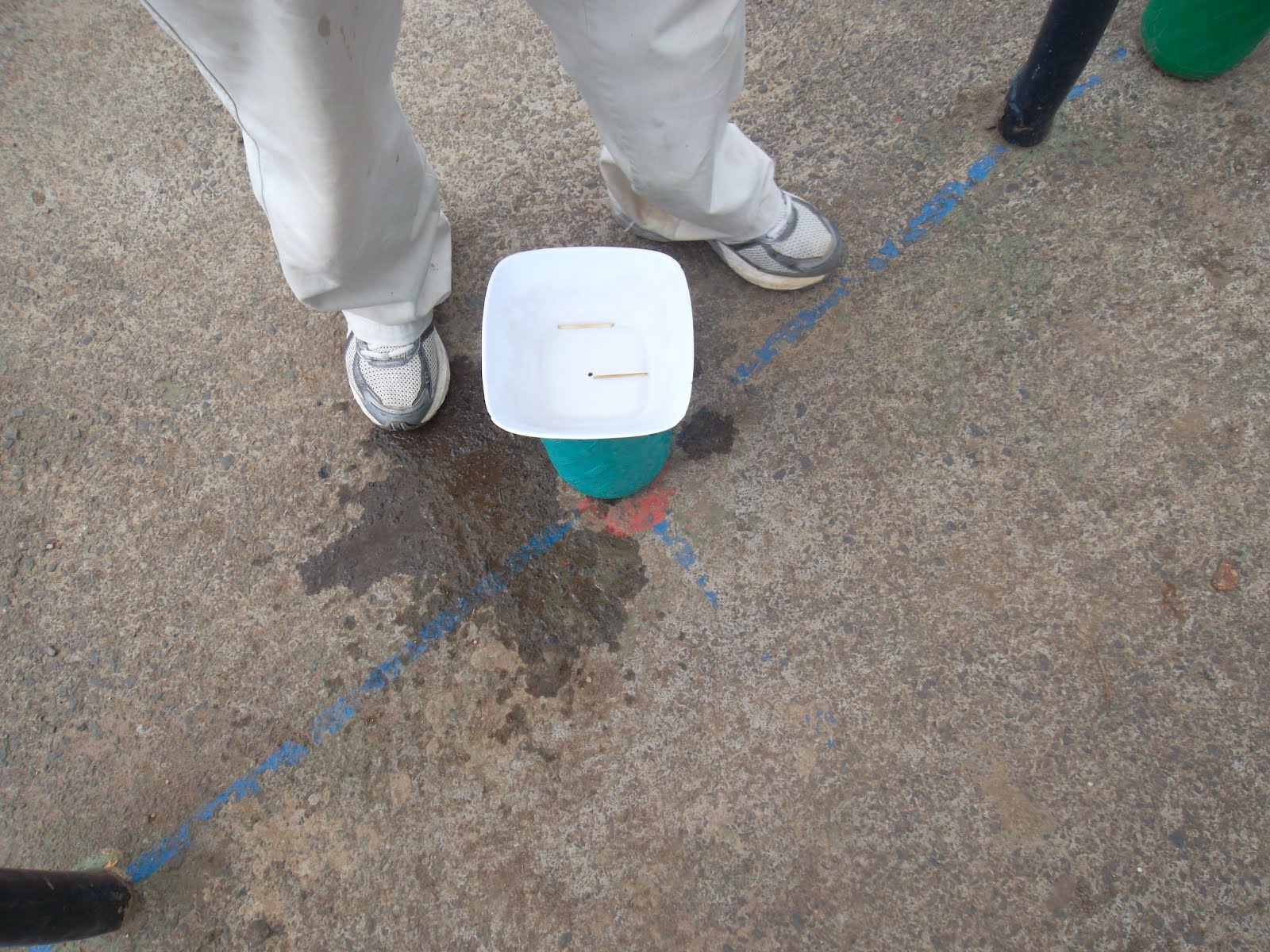
" The toothpick trick"- at the equator, a funny little tourist stop half way to Meru, where you pay 6 dollars or so for a man to take a toothpick in a bucket of water with a hole in the bottom, and you walk with him as he places it in front of the equator, on the equator and behind the equator line, watching the toothpick swivel in all different directions, on the line, of course it was dead even, no movement at all! Consider us impressed
" Exodus"- while I wasn't able to get any good pictures of our trip in the mud, this gives you a good idea of what happens to the roads during these storms, this was a path we followed for about 2km back to a greenhouse outside of Meru, the animals running made me think of us trying to escape the flash flood but inevitably being caught by it. I think these animals however are wise to the routine and are the first to get going at any sign of trouble.
 After a few days of solid work, Morgan and I are beginning to feel much more like we can play the role we were sent here to fulfill vet-wise. Many of the things we do on a farm in the course of the day would not be skills we would even come close to mastering until 3rd or even 4th year, let alone get the chance to perform on an almost daily basis. Maureen and Jeff have been truly endless in their aid, wisdom and beyond anything else, way of making us feel as though we are not only capable of being quick studies but are also peers who simply need a refresher course. Quickly things are becoming second nature which were before the kind of thing you would have to kind of wing for a bit. For example, when an instructor would ask, "So you can here the heart beat?" and you would nod in agreement, even though you had tried every possible way of hearing it and were coming up with nothing, simply to not feel like a fool. Now we can not only hear the heart beat (well, except for the times when the cow is so covered in layers of mud or manure that no tool could chisel its way through, let alone amplify sound), but capable of performing a RUMBA as Maureen calls it, an exam where we focus on the most important features of a cow's unique anatomy that are liable to fail or give need for veterinary care.
First you do the rumen, you press down hard on the left back end of the cow over the rumen with your stethoscope and try to hear three full rumen rotations, which sounds something like a thunderstorm as it fills and an ocean tide receding as it empties. Next the uterus, of course this involves a rectal exam, often in our case to confirm pregnancy, but here in Kenya we have the luxury of being able to feel quite a bit, given the lower than normal packing of the insides of the animal with fat. Most cows we have dealt with so far are not cycling, meaning their ovaries are very tiny, so if we can manage to first identify some landmarks like these, we can slowly begin to feel our way around and negotiate the rest. Children, who are often the inevitable onlookers to our visits, get a real kick out of this, especially upon entry, as to be fair to the cow you really need to lubricate your glove, which outside of the clinic, far from vet supply stores, means covering your glove in the the most fresh, moist manure you can find on the bottom of the pen. After this is complete, you move onto the next big anatomical site of concern, the mammary gland. As I am learning every cow's udder feels different. Some have hard quarters and they all feel swollen and lumped together while others are soft and fairly supple. We are reassured that if one of the quarters were "hot" (a hallmark of Mastitis, a common sometimes subclinical but often in these kind of regions clinical to acute case of bacterial infection) we would be able to tell, but I will have just have to believe them on this one. One of the big struggles we face with this organ here in Kenya and really many places in the world is focused on the debate of how best to milk a cow. While stripping it roughly between your fingers seems to be the method most commonly used, it can cause serious and long term trauma to the teat canal within each teat, which can cause the teat to become compromised, allowing bacteria to invade easily and colonize. We (Farmers Helping Farmers) have produced various fact sheets addressing this issue, with small little drawings to demonstrate the method we recommend, but every cow seems to react differently to this stripping method. Some seem to suffer at its harshness while others are resigned to a more complacent attitude towards it. We try to lead by example the best we can, first pinching of the very end of the teat closet to the body with your thumb and forefinger, than slowly compressing the milk down the teat canal by systematically applying pressure with each finger until you draw with your pinky, although we cannot change everything, some compromises need to be made. The next thing to check is the bronchial tree, using your stethoscope and visually checking for signs of heaving or heavy breathing. You begin listening directly behind the scapula region and then move back in a line towards the end of the lungs, constantly going back to your first point of listening to have a means of comparison. As the lungs are pretty long in the cow, this is one of the longest parts of the exam really, and in my opinion, the most likely part for you to miss something. Every cow breathing sounds quite different, but the major thing to watch for is weird background noises (swishy water sounds) or being able to physically hear expiration (as it should be passive, hence, soundless). Last is the all allusive abomasum, a funny little organ that can become displaced and can be detected using the ping method. Literally listening with your stethoscope while you ping around it with your thumb and forefinger, listening for a higher pitched ping in return. The higher pitch is obtained by the abomasum being displaced, presenting an area of gas to fluid interphase, which resonates when you ping it. We have yet to hear anything of this nature yet but Maureen is dead set that if it was there, and we were able to hear it, it would be the kind of diagnostic tool (in this case, noise) you would never need to be taught again. It must be quite the sound to hear, so we hope (but also of course being animal lovers), hope not to hear. Of course we do a lot of other things before we let the cow off the hook and call it within normal limits, but enough of that for now.
After a few days of solid work, Morgan and I are beginning to feel much more like we can play the role we were sent here to fulfill vet-wise. Many of the things we do on a farm in the course of the day would not be skills we would even come close to mastering until 3rd or even 4th year, let alone get the chance to perform on an almost daily basis. Maureen and Jeff have been truly endless in their aid, wisdom and beyond anything else, way of making us feel as though we are not only capable of being quick studies but are also peers who simply need a refresher course. Quickly things are becoming second nature which were before the kind of thing you would have to kind of wing for a bit. For example, when an instructor would ask, "So you can here the heart beat?" and you would nod in agreement, even though you had tried every possible way of hearing it and were coming up with nothing, simply to not feel like a fool. Now we can not only hear the heart beat (well, except for the times when the cow is so covered in layers of mud or manure that no tool could chisel its way through, let alone amplify sound), but capable of performing a RUMBA as Maureen calls it, an exam where we focus on the most important features of a cow's unique anatomy that are liable to fail or give need for veterinary care.
First you do the rumen, you press down hard on the left back end of the cow over the rumen with your stethoscope and try to hear three full rumen rotations, which sounds something like a thunderstorm as it fills and an ocean tide receding as it empties. Next the uterus, of course this involves a rectal exam, often in our case to confirm pregnancy, but here in Kenya we have the luxury of being able to feel quite a bit, given the lower than normal packing of the insides of the animal with fat. Most cows we have dealt with so far are not cycling, meaning their ovaries are very tiny, so if we can manage to first identify some landmarks like these, we can slowly begin to feel our way around and negotiate the rest. Children, who are often the inevitable onlookers to our visits, get a real kick out of this, especially upon entry, as to be fair to the cow you really need to lubricate your glove, which outside of the clinic, far from vet supply stores, means covering your glove in the the most fresh, moist manure you can find on the bottom of the pen. After this is complete, you move onto the next big anatomical site of concern, the mammary gland. As I am learning every cow's udder feels different. Some have hard quarters and they all feel swollen and lumped together while others are soft and fairly supple. We are reassured that if one of the quarters were "hot" (a hallmark of Mastitis, a common sometimes subclinical but often in these kind of regions clinical to acute case of bacterial infection) we would be able to tell, but I will have just have to believe them on this one. One of the big struggles we face with this organ here in Kenya and really many places in the world is focused on the debate of how best to milk a cow. While stripping it roughly between your fingers seems to be the method most commonly used, it can cause serious and long term trauma to the teat canal within each teat, which can cause the teat to become compromised, allowing bacteria to invade easily and colonize. We (Farmers Helping Farmers) have produced various fact sheets addressing this issue, with small little drawings to demonstrate the method we recommend, but every cow seems to react differently to this stripping method. Some seem to suffer at its harshness while others are resigned to a more complacent attitude towards it. We try to lead by example the best we can, first pinching of the very end of the teat closet to the body with your thumb and forefinger, than slowly compressing the milk down the teat canal by systematically applying pressure with each finger until you draw with your pinky, although we cannot change everything, some compromises need to be made. The next thing to check is the bronchial tree, using your stethoscope and visually checking for signs of heaving or heavy breathing. You begin listening directly behind the scapula region and then move back in a line towards the end of the lungs, constantly going back to your first point of listening to have a means of comparison. As the lungs are pretty long in the cow, this is one of the longest parts of the exam really, and in my opinion, the most likely part for you to miss something. Every cow breathing sounds quite different, but the major thing to watch for is weird background noises (swishy water sounds) or being able to physically hear expiration (as it should be passive, hence, soundless). Last is the all allusive abomasum, a funny little organ that can become displaced and can be detected using the ping method. Literally listening with your stethoscope while you ping around it with your thumb and forefinger, listening for a higher pitched ping in return. The higher pitch is obtained by the abomasum being displaced, presenting an area of gas to fluid interphase, which resonates when you ping it. We have yet to hear anything of this nature yet but Maureen is dead set that if it was there, and we were able to hear it, it would be the kind of diagnostic tool (in this case, noise) you would never need to be taught again. It must be quite the sound to hear, so we hope (but also of course being animal lovers), hope not to hear. Of course we do a lot of other things before we let the cow off the hook and call it within normal limits, but enough of that for now.
 Thursday came very quickly and all of the sudden we found ourselves being all too kindly invited to join our CIDA (one more time, Canadian International Development Agency) representative here at the Canadian High Commission in Nairobi, Melaine Boyd and her husband, along for a tour of some of the establishments and various organizations CIDA fully, or in part, helps support.
 While our travels for the next few days were many, I think it best for my counterparts who are posted in some of these organizations for the summer to speak to the nature of the programs much more deeply, so I have decided instead to present some poems and images with a bit of background which I wrote during this time.
 I will post them in the next blog along with an author's note explaining the nature of the subject or what drove me to write it. I have decided to take some creative license with my poems, so they will be of various non-formal and formal forms, but for all those reading keep in mind I will sometimes be dealing with somewhat sensitive subject matters and because of the nature of my writing style, I will be sure to follow certain words choices etc. up with explanation to avoid any offence or confusion over my meaning. All writers kind of need this disclaimer, especially as I represent a few organizations and wouldn't want there to be any mistakes understanding wise. Before I go for today, one story to recount from our travels at the end of this week.
 We were asked to visit one of the smaller cooperative dairies we work with, Exlewa, and host an informational meeting/afternoon with some of the farmers who are members of the dairy. It was scheduled for eleven, a time I knew before we even left in the morning we would have no chance of meeting, and I was quite right. By the time we had finished with the Muchui Women's group, visited a few schools, greenhouse operations and some other smaller venues, it was well past one o'clock before we rolled into the sleepy little town of Exlewa. Of course we were greeted with a lot of thanks, even though shortly after arriving we realized we had been keeping around thirty farmers waiting out in a field in the hot midday sun for over two hours. Even worse, somewhere along the line they had been lead to believe that we would be treating any sick animals, which of course we had not prepared for, so as we drove up to meet the farmers the street was lined with cows tied up or running lose, all waiting for hypothetical treatment even though we didn't even have any medications on us. Sadly things proceeded to get worse both in regards to our feelings of guilt and also I imagine in the farmer's feelings towards us (which of course was never outright displayed) as about ten minutes after we had opened up the floor for questions, a torrential downpour of rain began, sending everything living into hiding. No other venue could be arranged (one which could shield us all from the weather) so we were told, again pleasantly, to call it a day. Our drivers were extremely eager to get the heck out of this place, given that the roads are liable to flooding, although even referring to what happens to the roads here as flooding is a rather foolish understatement. Really what becomes of the road is more like a river and sure enough, we became caught up in it. Our car very slowly began to turn sideways and all of the sudden, regardless of how calm of driver Dominic was, our safari van was half flipped in the ditch. Quickly enough a little white car (presumably a 4-wheel drive) came rolling down the hill to rescue us, which subsequently ended up also sideways half flipped over in the ditch across from us. Shortly after, yet another vehicle came flying down the hill, which somehow managed to come to a halt in the middle of the road and as soon as it had stopped, about eight men poured out of it. Another 10-20 farmers were following the vehicle on foot and yet another dozen or more seemed to appear out of nowhere. They then attached a rope to the front of our car, which about a dozen or so men positioned themselves to haul on, while the rest of our rescuers got on the upside of the ditch hill and all at once, began to rock our van upwards. Rather quickly we were back upright and on the road, spinning down the hill, trying to swerve out of the way of other vehicles stuck. Finally we managed to get out of the town's roadways and back onto the main road and all had a good laugh at how within one week in country we had already experienced one of what is considered the true Kenyan moments, which is being stuck in the mud exactly as we were. Who knows how many more "Kenyan moments" we will cross off of the potential list by the end of our time here, hopefully, many.
 Back on the road, we stopped to confirm with Mrs. Boyd and her driver, who had been wiser than us, in addition to the fact that we had let them leave first, as they needed to be back to the embassy by dark ( a common thing here) which I highly doubt they were able to do. She had stopped on the side of the road to wait for us and seemed quite concerned, oddly, she was really the only one out of the entire party, both us and drivers, to be truly concerned, so we thanked her again for the trip and parted ways. We stayed on an additional night in Meru, a kind of crowded, dirty city really, but still alive with a lot of people. Meru is listed as one of the priority areas for the government aid wise, as it suffers from intense dry spells, which furthers the difficulty and poverty found in the region imposing upon constant life. Jennifer, our Meru godmother (she has opened her extensive house to us as an organization about 3-4 times a year for the last decade or so) was relieved to see us pull into the driveway, all be in, covering in mud, and as we sat out and had a lovely drink in her lawn, speaking of politics and what the new constitution ( a document discussed for a long period of time here in Kenya, but only finally granted last year) would mean in the coming year and the election in December. Carolyn, an education coordinator from PEI is concerned of the time overlap between the election and her students arriving, Jennifer is confident things will be ok but also is not blind to how long and difficult change in government can be (in any part of the world). Let's hope for our peers coming here, or back here next year, things go well, only time will tell.
I'm off for now, look for my next postings soon, as I add this sentence to a blog made nearly 3 weeks ago now!
Jen
Images:
"Tulip factory" on the way to Meru, supported in part by CIDA
"The group"- from left, Jeff, Shaad, Gerald, Melaine Boyd and husband, Morgan and me!
"On the run"- chicks outside of a greenhouse in Meru, you guessed it, sponsored by CIDA
" An elephant!"- you can imagine our shock when our driver Dominic told us we would be driving through an area elephants often were found blocking the road, he wasn't kidding, about 5 minutes later we pulled over to watch this amazing creature eating a few feet away from the main road
" The toothpick trick"- at the equator, a funny little tourist stop half way to Meru, where you pay 6 dollars or so for a man to take a toothpick in a bucket of water with a hole in the bottom, and you walk with him as he places it in front of the equator, on the equator and behind the equator line, watching the toothpick swivel in all different directions, on the line, of course it was dead even, no movement at all! Consider us impressed
" Exodus"- while I wasn't able to get any good pictures of our trip in the mud, this gives you a good idea of what happens to the roads during these storms, this was a path we followed for about 2km back to a greenhouse outside of Meru, the animals running made me think of us trying to escape the flash flood but inevitably being caught by it. I think these animals however are wise to the routine and are the first to get going at any sign of trouble.
Back on the road, we stopped to confirm with Mrs. Boyd and her driver, who had been wiser than us, in addition to the fact that we had let them leave first, as they needed to be back to the embassy by dark ( a common thing here) which I highly doubt they were able to do. She had stopped on the side of the road to wait for us and seemed quite concerned, oddly, she was really the only one out of the entire party, both us and drivers, to be truly concerned, so we thanked her again for the trip and parted ways. We stayed on an additional night in Meru, a kind of crowded, dirty city really, but still alive with a lot of people. Meru is listed as one of the priority areas for the government aid wise, as it suffers from intense dry spells, which furthers the difficulty and poverty found in the region imposing upon constant life. Jennifer, our Meru godmother (she has opened her extensive house to us as an organization about 3-4 times a year for the last decade or so) was relieved to see us pull into the driveway, all be in, covering in mud, and as we sat out and had a lovely drink in her lawn, speaking of politics and what the new constitution ( a document discussed for a long period of time here in Kenya, but only finally granted last year) would mean in the coming year and the election in December. Carolyn, an education coordinator from PEI is concerned of the time overlap between the election and her students arriving, Jennifer is confident things will be ok but also is not blind to how long and difficult change in government can be (in any part of the world). Let's hope for our peers coming here, or back here next year, things go well, only time will tell.
I'm off for now, look for my next postings soon, as I add this sentence to a blog made nearly 3 weeks ago now!
Jen
Images:
"Tulip factory" on the way to Meru, supported in part by CIDA
"The group"- from left, Jeff, Shaad, Gerald, Melaine Boyd and husband, Morgan and me!
"On the run"- chicks outside of a greenhouse in Meru, you guessed it, sponsored by CIDA
" An elephant!"- you can imagine our shock when our driver Dominic told us we would be driving through an area elephants often were found blocking the road, he wasn't kidding, about 5 minutes later we pulled over to watch this amazing creature eating a few feet away from the main road
" The toothpick trick"- at the equator, a funny little tourist stop half way to Meru, where you pay 6 dollars or so for a man to take a toothpick in a bucket of water with a hole in the bottom, and you walk with him as he places it in front of the equator, on the equator and behind the equator line, watching the toothpick swivel in all different directions, on the line, of course it was dead even, no movement at all! Consider us impressed
" Exodus"- while I wasn't able to get any good pictures of our trip in the mud, this gives you a good idea of what happens to the roads during these storms, this was a path we followed for about 2km back to a greenhouse outside of Meru, the animals running made me think of us trying to escape the flash flood but inevitably being caught by it. I think these animals however are wise to the routine and are the first to get going at any sign of trouble.