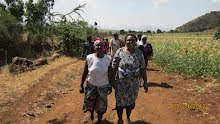
Hello Readers,
We are currently in Mukurwe-ini working with the Wakulima Dairy. The past 2 weeks have been relatively uneventful as we have been doing a lot of data entry etc.
Last Sunday however we attended church services at a girl’s secondary school in Meru with Jennifer. It was fun and the girls were all very interested in us. I recently (through Farmers Helping Farmers) donated funds to pay for a girl’s secondary education, and while at the church services was able to meet the girl. It was very touching.
Last Monday we came to Ishamara and to even hotter weather than Meru. We had meetings with Duncan in the beginning of the week, he is such a helpful man. We spent the next two days interviewing all the members of the board of directors for Wakulima. Regina came with us to translate and show us where to go, what an amazingly helpful woman.
Yesterday we spent the day talking to the staff, management and customers of the Wakulima Dairy SACCO. The customers are so interesting and had a lot of really good answers, and most if not all told us how thankful they were for the Dairy. When asked what impact the Dairy has had on her life one woman looked at me and said ‘’now we are full!’’ while patting her belly.
Next week we will be going to do work at the Dairy itself, as well as on a milk run, which we are all excited about. Also, we are patiently counting down the days until Dr C. Lacroix comes from UPEI (seven more).
Chelsea Morrison
Saturday, October 20, 2007

Tuesday, October 9, 2007
Kinyinjere Primary School


by Julie Mutch
Another week has gone by in our internship to Kenya and we spent the week with members of the Muchui Women’s Group. At the end of the week we spent the day at Kinynjere Primary School. The school is twinned with a class at Tracadie School on PEI.
The purpose of our visit to the school was to hand out mosquito nets to the special needs class, as well as the nursery kids ( kindergarten ). We handed out nets to the rest of the school 2 weeks ago. This is the first time most of them would have mosquito nets to sleep under. The kids were very excited to see us again. After we handed them nets, the children began singing for us. They were so good! Eventually, more of the children came out of their classrooms and joined in. ( I don’t think much work got done that day in class!)
During the lunch break, we passed out candy to every student at the school. They were very excited to receive a small gift! Also during lunch, we invited all the students out onto the football field and gave them a brand new football ( soccer ball to us). Last time we were at the school we noticed that they were playing football with a small piece of rubber taped together, so we decided we would get them a new football to play with at lunch. The girls played a game, then the boys. We somehow then got asked to come into a couple classrooms while the teachers were having lunch. The students asked us to teach them something. Anything at all. All they wanted to do was learn. We let them ask us questions - about anything at all and tried our best to answer them! They were very curious about the Canadian school system and how it was different, and Katie got some questions on biology as well!
In the afternoon we held a small focus group with children that have a parent in the Muchui group. There were 6 at that school. We asked them about the women’s group and how it has made a difference in their lives. Their responses were excellent, and heartbreaking at the same time. Most explained that before they had water tanks( from the women’ s group) , they would have to miss school to walk to get water from the stream, and that many times they would not have any food at their house and the women’s group would feed them. Now, because of the group, their parents are making some money, and able to plant tree seedlings and sell them. They all realized that education was the only way out of poverty for them, and that farming in that area was very tough because of drought.
This coming week we are continuing our work with the Muchui Group. It will be our last week in Meru!
The purpose of our visit to the school was to hand out mosquito nets to the special needs class, as well as the nursery kids ( kindergarten ). We handed out nets to the rest of the school 2 weeks ago. This is the first time most of them would have mosquito nets to sleep under. The kids were very excited to see us again. After we handed them nets, the children began singing for us. They were so good! Eventually, more of the children came out of their classrooms and joined in. ( I don’t think much work got done that day in class!)
During the lunch break, we passed out candy to every student at the school. They were very excited to receive a small gift! Also during lunch, we invited all the students out onto the football field and gave them a brand new football ( soccer ball to us). Last time we were at the school we noticed that they were playing football with a small piece of rubber taped together, so we decided we would get them a new football to play with at lunch. The girls played a game, then the boys. We somehow then got asked to come into a couple classrooms while the teachers were having lunch. The students asked us to teach them something. Anything at all. All they wanted to do was learn. We let them ask us questions - about anything at all and tried our best to answer them! They were very curious about the Canadian school system and how it was different, and Katie got some questions on biology as well!
In the afternoon we held a small focus group with children that have a parent in the Muchui group. There were 6 at that school. We asked them about the women’s group and how it has made a difference in their lives. Their responses were excellent, and heartbreaking at the same time. Most explained that before they had water tanks( from the women’ s group) , they would have to miss school to walk to get water from the stream, and that many times they would not have any food at their house and the women’s group would feed them. Now, because of the group, their parents are making some money, and able to plant tree seedlings and sell them. They all realized that education was the only way out of poverty for them, and that farming in that area was very tough because of drought.
This coming week we are continuing our work with the Muchui Group. It will be our last week in Meru!
Saturday, September 29, 2007
Ruuju Women's GRoup

Ruuju Women’s Group

by Julie Mutch
It is hard to believe that it is the end of our third week here in Kenya. This past week we were working with the Ruuju Women’s Group. The hour long trek out to Ruuju is an adventure in itself, and I must say I won’t be missing that part!
Shaad, the FHF Field officer here in Kenya that oversees the 5 projects was our driver all week. It was really fun having him join us. For anyone that has met Shaad, he is very fun to be around and always knows the answer to every question you have! I don’t know what we are going to do without him around! Though, he will be coming to check up on us as we move through the projects during our 12 weeks.
Our task at Ruuju was to gather information about the women in the group, and also to gather some information on the FHF Council. We conducted 30 interviews at member’s farms throughout the week and two members of the group acted as translators for us. All of the women we met were very kind and welcoming to us. We got to see a wide variety of farms, anywhere from 1/8 acre to 17 acre farms. We also saw how much the women’s group has done for the community. All of the women were very thankful for the group. Through the group, the women have received water tanks, farm animals, bedding, kitchen utensils, school fees, just to name a few. We also got to see what the women grew on their farms, and what they would like to grow in the future. The main reason that these women lost a lot of their crop was because of drought and disease.
As a thank you to the women for allowing us to visit their farms, we gave each woman 5 packages of seeds donated by Vesey’s Seeds in York, PEI. They were very thankful for the seeds. Though nothing was expected from the women besides their time and willingness to answer our questions, we received many gifts in return. We took home two live chickens (which I’m sure we’ll be having for supper some day soon...!), many bananas, black beans, ground nuts, papayas, avocado, squash, fresh eggs, and one member even gave us handmade fruit baskets.
The response from the women was overwhelming. Even though those these women have very little, they still were quite happy to give us so much.
Next week we are starting our work with the Muchui Women’s Group. We will be working with them for the next two weeks.
It is hard to believe that it is the end of our third week here in Kenya. This past week we were working with the Ruuju Women’s Group. The hour long trek out to Ruuju is an adventure in itself, and I must say I won’t be missing that part!
Shaad, the FHF Field officer here in Kenya that oversees the 5 projects was our driver all week. It was really fun having him join us. For anyone that has met Shaad, he is very fun to be around and always knows the answer to every question you have! I don’t know what we are going to do without him around! Though, he will be coming to check up on us as we move through the projects during our 12 weeks.
Our task at Ruuju was to gather information about the women in the group, and also to gather some information on the FHF Council. We conducted 30 interviews at member’s farms throughout the week and two members of the group acted as translators for us. All of the women we met were very kind and welcoming to us. We got to see a wide variety of farms, anywhere from 1/8 acre to 17 acre farms. We also saw how much the women’s group has done for the community. All of the women were very thankful for the group. Through the group, the women have received water tanks, farm animals, bedding, kitchen utensils, school fees, just to name a few. We also got to see what the women grew on their farms, and what they would like to grow in the future. The main reason that these women lost a lot of their crop was because of drought and disease.
As a thank you to the women for allowing us to visit their farms, we gave each woman 5 packages of seeds donated by Vesey’s Seeds in York, PEI. They were very thankful for the seeds. Though nothing was expected from the women besides their time and willingness to answer our questions, we received many gifts in return. We took home two live chickens (which I’m sure we’ll be having for supper some day soon...!), many bananas, black beans, ground nuts, papayas, avocado, squash, fresh eggs, and one member even gave us handmade fruit baskets.
The response from the women was overwhelming. Even though those these women have very little, they still were quite happy to give us so much.
Next week we are starting our work with the Muchui Women’s Group. We will be working with them for the next two weeks.
Wednesday, September 26, 2007
Rael Kimathi uses drip irrigation to grow green vegetables and tomatoes on her small farm.

by Teresa Mellish
Rael Kimathi is a very good farmer. Her homestead has many trees and her crops always look the best in the area, even in the drought. Her farm is located beside the Muchui Business Centre and she is both a sponsor of the Centre and benefits from the technologies at the Centre. She is member of the Muchui Womens Group and her daughter, Salome, works at the Muchui Business Centre. She has donated a piece of land to the Muchui Womens Group for the “mother plot” where they have planted the improved varieties of macadamia, passion fruit, bananas and mangoes to be used for grafting.
She is now building a big greenhouse on her farm- which will use drip irrigation to grow tomatoes for sale. She is already scaling up the technology Farmers Helping Farmers introduced to the Muchui Womens Group
When I visited the Kiirua district last week, it was dry and very windy. No crops were growing and the area did not receive the last rains. Rains are expected in mid-October and always optimistic farmers are plowing and preparing the land to sow seeds before the rain.
This is where the members of the Muchui Womens Group farm. Each of the members has a water tank and most of them are hooked up to the water pipe which brings water from Mount Kenya into the area. However there is no rain water in the tanks and it is expensive to purchase water from the water pipes; it costs 250 Kenya shillings (CAD$4) to fill the 4600 litre water tank. Consequently water is used frugally and sparingly.
It was so wonderful to see some green crops amidst the otherwise brown vegetation on the three farms I visited. These farms are using drip irrigation in their kitchen gardens to grow kale for home consumption. As a result, the diets of these families includes kale, served in the form of “sukuma wiki”- much like boiled spinach or swiss chard with onions.
We also saw drip irrigation in the small greenhouses which are being used to grow tomatoes for home consumption and for sale. The variety of tomatoes has been developed for greenhouses. Rael Kimathi said she has already sold tomatoes worth 1000 shillings.
The drip irrigation pipes lay on the ground and have a small hole at spaced intervals to allow water to drip out at exactly the same place as one kale plant is located. No water is lost to evaporation.
This has been possible for two reasons. The technology and materials for drip irrigation are available in Kenya because of the large scale greenhouses used to grow vegetables and flowers for export from Kenya. When we were in Kenya in January, 2007, we found a supplier of the pipes for the Muchui Women members.
Six donors to our 2006 Christmas campaign each donated $100 for a vegetable garden for a family. We used these funds to set up the six greenhouses at the homes of six members of the Muchui Womens Group to demonstrate the drip irrigation.
As a result, all of the 62 Muchui group members now want drip irrigation!! Martin, horticulturist at the Muchui Business Centre, priced the drip irrigation materials for the members. The 1200 shillings required to purchase the drip materials was obtained by selling maize to the Business Centre and providing an additional 300 shillings each.
We continue to be amazed by the willingness of the Muchui Group members to try new technology. These women are traditional farmers who are not in a position to risk anything. There are several women in the group, such as Rael Kimathi. who are exceptionally good farmers and who are always the first to try new methods. The others see the new technology and then are willing to use it on their farms. Our lesson is that with appropriate technology and financial support direct to the farms, we can help improve the quality of their lives.
We will continue to work with these women to identify new crops and different ways for them to grow food to support their families.
Wednesday, September 19, 2007
Bed nets given to Kenyan tudents


Bed nets were given today to 300 pupils and teachers at two schools, the Kiirua Boys Secondary School and the Kinyinjere Primary School. These bed nets will be used to cover the beds of the students while they sleep so they will not be bitten by mosquitoes which may transmit malaria to the students.
The nets were purchased from funds donated by the Summerside Intermediate School. There are 122 pupils at at the Kiirua Boys Secondary School in Forms 1 through 4 (equivalent to Grades 9 through 12 in Canadian schools) ; most stay in dormitories and we purchased double bed size, extra long rectangular nets so they would cover bunk beds. The 158 students in Standard 1 to 8 (equivalent ot grades 1 to 8 in our Canadian schools) are all day-school students, so we purchased single bed conical nets for them to use in their homes.
The nets were purchased from funds donated by the Summerside Intermediate School. There are 122 pupils at at the Kiirua Boys Secondary School in Forms 1 through 4 (equivalent to Grades 9 through 12 in Canadian schools) ; most stay in dormitories and we purchased double bed size, extra long rectangular nets so they would cover bunk beds. The 158 students in Standard 1 to 8 (equivalent ot grades 1 to 8 in our Canadian schools) are all day-school students, so we purchased single bed conical nets for them to use in their homes.
The nets we purchased were recommended by the Canadian Red Cross and all nets were treated with insecticide.
Chelsea Morrison, one of the UPEI interns, hands a net to a student at the Kirua Boys Secondary School.
One of the students at the Kinyinjere Primary School stands beside her bed net in her home with Jennifer Murogocho, Chairperson of the Muchui Womens Group.
Chelsea Morrison, one of the UPEI interns, hands a net to a student at the Kirua Boys Secondary School.
One of the students at the Kinyinjere Primary School stands beside her bed net in her home with Jennifer Murogocho, Chairperson of the Muchui Womens Group.
A student at the Kiirua Boys Secondary School stands beside the bed net which covers 4 bunk beds in the dormitory.
Sunday, September 16, 2007
Bio gas generator changed our lives


Robert, one of the directors of the Mukurwe-ini Wakulima Dairy Limited, told Teresa Mellish that the bio-gas generator on his farm changed their lives.
He showed us the biogas generator which was installed in March 2007. Robert farms on steep land so the bio gas unit is located above his house.
He puts one bucket of manure from his dairy cows and two buckets of water into one end of the heavy gauge plastic tube each day. He takes the same amount of composted manure from the other end of the tube each day.
The composted manure is put on his napier grass to fertilize the grass and is used to grow kale for family consumption.. The nutrients in the manure are more readily available to produce crops than the raw manure which is put into the bio gas generator.
The methane produced by the bio gas generator is carried through a plastic pipe into his house to a burner. He said they could cook food for three to four hours each day with the methane.
Robert said that his mother is delighted that there is no need to gather or carry fire wood any more for cooking food and there is no smoke in the cooking area. He told us that his mother is amazed that cows can produce fuel for cooking!!!
Robert is milking three cows now and expects a couple to freshen soon. He milks his cows three times a day. The milk from the first two milkings is sold to the dairy and the milk from the third milking is used for the family’s consumption. Robert’s farm is half an acre.
We were told that the materials for Robert’s heavy gauge bio gas unit cost 28,000 shillings ($430) and it is supposed to last for 10-15 years. (We were also told that the price has gone up to 34,000 shillings or $525). Materials for a lighter gauge unit cost 15,000 shillings ($250).
Funds for this bio gas generator were donated by the Rotary Club of Stratford.
He showed us the biogas generator which was installed in March 2007. Robert farms on steep land so the bio gas unit is located above his house.
He puts one bucket of manure from his dairy cows and two buckets of water into one end of the heavy gauge plastic tube each day. He takes the same amount of composted manure from the other end of the tube each day.
The composted manure is put on his napier grass to fertilize the grass and is used to grow kale for family consumption.. The nutrients in the manure are more readily available to produce crops than the raw manure which is put into the bio gas generator.
The methane produced by the bio gas generator is carried through a plastic pipe into his house to a burner. He said they could cook food for three to four hours each day with the methane.
Robert said that his mother is delighted that there is no need to gather or carry fire wood any more for cooking food and there is no smoke in the cooking area. He told us that his mother is amazed that cows can produce fuel for cooking!!!
Robert is milking three cows now and expects a couple to freshen soon. He milks his cows three times a day. The milk from the first two milkings is sold to the dairy and the milk from the third milking is used for the family’s consumption. Robert’s farm is half an acre.
We were told that the materials for Robert’s heavy gauge bio gas unit cost 28,000 shillings ($430) and it is supposed to last for 10-15 years. (We were also told that the price has gone up to 34,000 shillings or $525). Materials for a lighter gauge unit cost 15,000 shillings ($250).
Funds for this bio gas generator were donated by the Rotary Club of Stratford.
Monday, September 10, 2007
Beef farmers talk the same language all over the world
 The Ole Sein family in Kiserian, Kenya are very interested in the photos Julie Mutch of Earnscliffe, PEI is showing them of the Angus beef cattle on her family's farm.
She had just finished visiting the Ole Sein farm where they have beef cattle, sheep and goats.
Julie is in Kenya with two other UPEI interns, Chelsea Morrison and Katie Testu.
They will be documenting work on the governance of several Farmers Helping Farmers projects.
Subscribe to:
Posts (Atom)